Major Arcana · 16
The Tower
- upheaval
- sudden change
- revelation
- awakening
The Tower points to sudden change: something that looked solid breaks, often because it was weak for a long time. It covers shock, exposure, and change you did not choose. Upright, it is disruptive but clarifying. Reversed, it points to a collapse that is delayed, survived, or narrowly avoided.
- Element
- Fire
- Astrology
- Mars
- Numerology
- 16, four times four: structure pushed to its breaking point
- Yes or no
- no
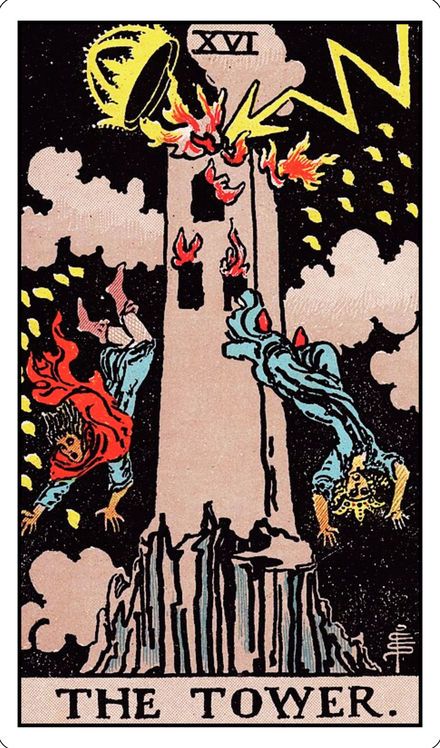
The lightning comes from outside the frame. You see where it lands but never where it starts, and that is the most true-to-life part of the picture.
Nobody experiences this kind of event as the logical end of anything. From inside, it feels like bad weather out of a clear sky. Only later, sometimes much later, can you see the cracks that were there all along.
The Tower upright meaning
Something that looked solid breaks, suddenly and without warning.
The Tower is the deck's most abrupt card. Waite said it plainly shows ruin in every aspect, and called it above all a card of unforeseen catastrophe. He read it as the ruin of a house of falsehood. His meanings were distress, adversity, calamity, disgrace, deception, and ruin. It points to something breaking quickly and not on your terms. That might be a belief you built your life around, a plan that stops working, or a secret coming out. There is no comfortable version of this card. It does offer one real comfort: it tends to hit things that were already weak. It points to what was held up by force, by avoidance, or by everyone agreeing not to look. The break feels sudden, but the weakness was usually there for a long time. That is why people often feel relief afterward, and then feel guilty about the relief. The card marks the fall. It does not decide what comes next, and the hardest part is often the first few weeks.
The Tower reversed meaning
A collapse that is delayed, survived, or narrowly avoided.
Reversed, The Tower can mean three different things. Waite's reversal was the same in a lesser degree, along with oppression and imprisonment. The first is a near miss: something almost fell apart and did not, and the relief is real. The second, and most common, is a collapse being put off. Something feels unsound, and a lot of effort is going into keeping it standing. The card asks what that effort is costing you. Putting off a break usually makes it more expensive. The third is the aftermath: the fall already happened and you are sorting through what is left. That is a quieter kind of hard, and the card is gentler here. It can also point to resisting a needed change so hard that the pressure builds, and the eventual break is worse for it.
A reversal is rarely the upright card's opposite. Reversed tarot cards covers the four conditions a reversal usually describes, and how to tell which one a spread is asking for. Every card's reversed meaning sits beside its upright one on reversed tarot card meanings.
The Tower in Waite's 1910 key
The meanings above are Reflecta's reading. These are the ones A. E. Waite gave in The Pictorial Key to the Tarot (1910), the guide he wrote for the deck Pamela Colman Smith drew. He wrote them for fortune-telling, a use tarot took on centuries after it began as a card game in fifteenth-century Italy. Some of his words are blunt, and none of them can tell you what will happen.
- Upright
- Misery, distress, indigence, adversity, calamity, disgrace, deception, ruin. It is a card in particular of unforeseen catastrophe.
- Reversed
- According to one account, the same in a lesser degree; also oppression, imprisonment, tyranny.
Symbolism in the card
- The crown being blown off the top
- Authority falls first. Before the walls go, the story that everything was solid stops being believable.
- The two figures falling head first
- Nobody climbs down calmly. This kind of change rarely comes with a planned exit, and it is hard to keep your dignity while it happens.
- The lightning striking from outside the frame
- The cause is out of view. It comes from somewhere the people inside could not see, which is how these events feel when you are in one.
The Tower in love and relationships
Upright. A relationship shaken suddenly, or news that changes how you see it. The card cannot tell you what happened or what anyone did. It can point to something that needed to break, even if you did not want it to, and ask what was being held up by force.
Reversed. A relationship that gets through a crisis, or a breakup that drags on. It can also point to a hard conversation being avoided because it would change everything, and the avoiding is costing you both.
The Tower in career and work
Upright. A plan falling apart, an unstable situation at work, or a sudden change in where you stand. Looking back, it is rarely a total surprise. The card favors facing the new facts quickly and letting the old plan go.
Reversed. A restructure you got through, or an unstable situation being propped up. If you keep working hard to rescue something that keeps needing rescue, this card may be describing that.
The Tower in money
Upright. Money feels unstable: an arrangement that may not hold, or a weak spot that was already there. The card cannot predict a loss. It can ask where your footing feels unsure, and a qualified advisor can help you decide what to do.
Reversed. A money crisis narrowly avoided, or debt that keeps getting managed and never quite solved. The card asks if you are fixing the problem or only putting it off.
The Tower as feelings
Upright. As feelings, The Tower describes something sudden and overwhelming. It could be falling for someone, falling out with them, or a realization that changes everything at once. It is intense and hard to control. The card cannot read another person's heart. It describes the mood around you and asks how you want to handle it.
Reversed. Reversed, it can describe a strong feeling someone is holding down, or the shaky time after one. The card cannot tell you what is happening inside another person. It can ask what you need while things are unclear.
The Tower in a reading position
The same card answers differently depending on what the position asked it. These are the readings for the positions people ask about most.
The Tower in the past position
Upright. Something fell, and that fall still shapes things now. What broke was probably weak long before it broke, so the fall revealed a problem that was already there.
Reversed. A collapse you survived, put off, or narrowly missed. The effort of holding things together is what carried forward. Delays like this usually make the final cost higher.
The Tower in the present position
Upright. Something is shaking now, and not on your terms. The card's comfort here is real: it points to what was held up by force. The worst of it is often the first couple of weeks.
Reversed. A lot of effort may be going into keeping something standing that feels unsound. The question here is what holding it up is costing you.
The Tower in the future position
Upright. Here the card points to something that may not hold if nothing changes. You cannot predict where the lightning strikes. What helps is being willing to look at what everyone has been avoiding.
Reversed. A break that may be postponed, and pressure held back this long tends to land harder. Less often, it nearly goes and then holds. The future here is still open.
Past, present and future are the three positions of the three card tarot spread, which explains why the past card is read as a cause and the future card as a direction of travel that can still change.
Is The Tower a yes or a no?
Upright, it leans no. Reversed, it leans no.
Upright it leans firmly no. Whatever you are asking about may not continue in its current form. Reversed it also leans no, just more slowly. It often means a collapse is being put off, and putting it off tends to make it cost more. The card shows how sound things are. It cannot decide the outcome.
Every card's leaning in one table, upright and reversed, is on yes or no tarot, along with what a maybe is asking you to do.
The Tower as a birth card
772 of the 36,890 dates between 1925 and 2025, 2.1% of them, give The Tower as a first birth card, and it never arrives on its own. 16 reduces to 7, so The Chariot is always the card underneath it.
Which card is yours comes from your birthday rather than from the deck. The tarot birth card calculator runs the reduction on a date of birth and shows every step of it. The date stays in the browser.
The Tower card combinations
- +The Tower and Death
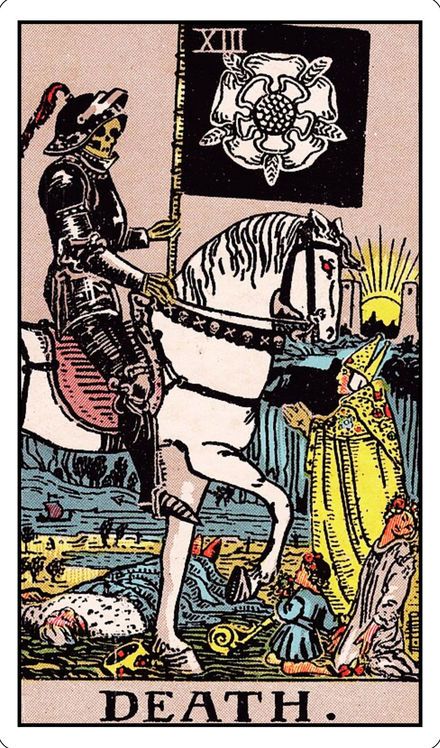
- Something that was slowly ending, finished suddenly. Together they can point to an ending brought on by an outside event, with nobody choosing it.
- +The Tower and The Star
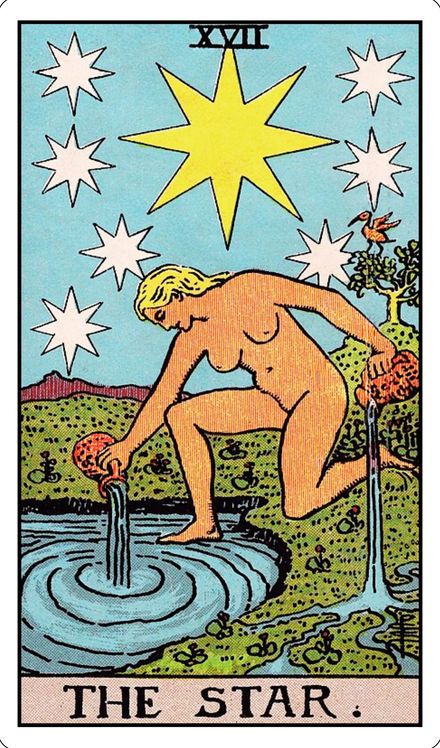
- The best-known sequence in the deck, and the most hopeful. The Star follows The Tower: collapse, then recovery. The pairing suggests you can get through what comes after.
- +The Tower and The Devil
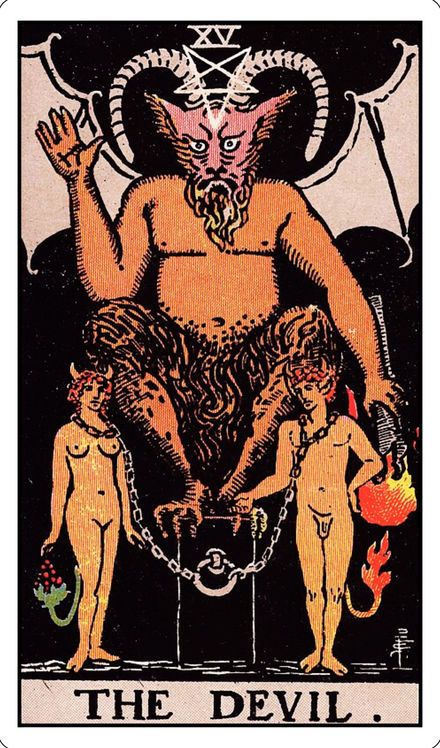
- A trap broken from outside. Sometimes an unhealthy situation only ends when something external forces it. People often call it the best bad thing that happened to them.
- +The Tower and The Emperor
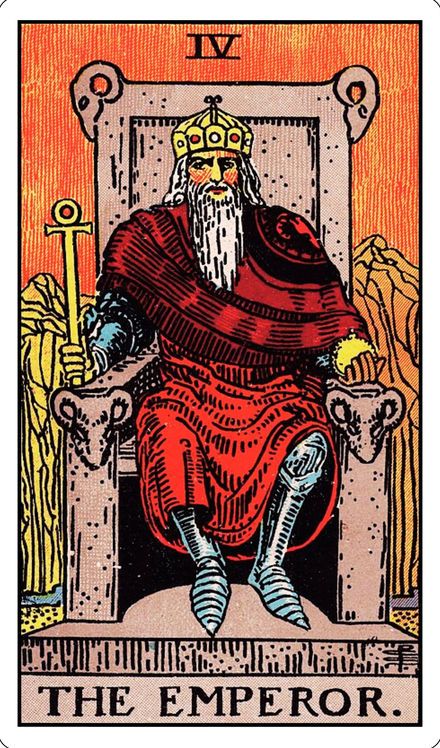
- Structure failing. Together they can point to something held up by force and control. Strong management delayed the collapse but could not prevent it.
Every pairing on this site, The Tower's included, is collected on tarot card combinations.
I can let the false part fall and keep what holds.
The Tower: common questions
- What does The Tower card mean?
- It points to sudden change, where something that looked solid breaks. Often it was weak for a long time. It covers shock, exposure, and change you did not choose. Waite called it a card of unforeseen catastrophe. Upright it is disruptive but clarifying. Reversed it points to a collapse that is delayed, survived, or narrowly avoided.
- Is The Tower always bad?
- It is always disruptive. It is not always bad. It tends to hit things held up by force or by everyone agreeing not to look, and it leaves sound things alone. That is why people often feel relief afterward. The card marks the fall and leaves what happens next open.
- What does The Tower mean in love?
- A relationship shaken suddenly, or news that changes how you see it. The card cannot say what anyone has done. It can point to something that needed to break, even if you did not want it to. Reversed, it can point to a crisis you get through or a breakup that drags on.
- What comes after The Tower?
- In the deck's order, The Star comes next, and readers treat that as meaningful. It is the most hopeful pairing in the deck: collapse, then recovery. In practice, the hardest part of a Tower moment is usually the first few weeks.
There is also a page on what Reflecta does with a reading once the cards are down.