How to read tarot
Reading tarot is three skills: asking a question the cards can answer, knowing roughly what each card means, and reading the cards in relation to each other rather than one at a time. The third is the one that separates a reading from a lookup, and it is the one nobody teaches first.
Most guides to reading tarot start with the cards. That is the wrong end. The cards are the part you can look up, and looking them up is not the difficult bit.
The question does most of the work
A reading is only as good as what you asked. This sounds like a platitude and is mechanical: the same card means different things in response to different questions, so a vague question produces a vague answer no matter which cards turn up.
Two things make a question work. It should be answerable in a sentence, and it should be open rather than closed. “Will he call me” gives the cards almost nothing to do. “What is going on between us” gives them a situation to describe. The second question is also, usually, the one you wanted answered.
Questions about when fail the same way. “When will I meet someone” asks the deck for a date it does not have. “What do I want from the next person” gives it something to work on.
The most common failure is stacking. People ask what looks like one question and is really four: should I take this job, and will I regret leaving, and is my manager going to be difficult about it, and am I making this decision for the right reasons. Pick one. The others are separate readings.
Learn the suits before you learn the cards
There are 78 cards and you do not need to know them all to start. You need to know four things:
- Cups are feeling. Love, friendship, grief, intuition.
- Pentacles are material. Money, work, health, home.
- Swords are mind. Thought, conflict, truth, and the damage both clarity and its absence can do.
- Wands are drive. Creativity, ambition, momentum.
That alone lets you read a spread usefully. If someone asks about a practical problem and draws four Cups cards, you already know something important before you have identified a single card: they framed it as practical and it is not.
The Major Arcana are the 22 cards without a suit, and they cover the larger forces. Several of them in one spread usually means the situation is bigger than the question being asked about it.
Read the cards together
This is the skill, and it is the one most people never get taught.
A beginner reads a three card spread as three separate answers: this card means X, this one means Y, this one means Z. An experienced reader reads it as one sentence. The meaning lives in the movement between the cards.
If that distinction is easier to see than to describe, three card tarot reading examples is this section demonstrated: four readings worked all the way through, each one turning on what two of the cards say about each other rather than on any card alone.
Concretely, look for:
- Suit changes. A spread that starts in Swords and ends in Cups is a situation moving from conflict into feeling, whatever the individual cards say.
- Number direction. Ascending numbers suggest something building. Descending ones suggest something winding down.
- Repetition. Three cards of the same suit is the spread showing you what kind of problem this is.
- Whether the last card follows. If the outcome card is a natural consequence of the present card, current conditions hold. If it is not, something has to change for it to arrive, and working out what is usually the most useful part of the reading.
The join between two cards is easier to learn from examples than from rules. Tarot card combinations collects every pairing on this site in one place, each written as the single sentence the two cards make together rather than as two meanings placed side by side.
What to do with a card you do not like
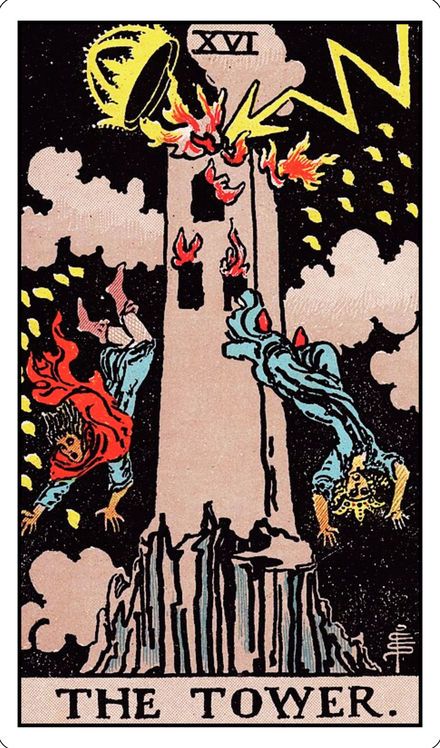
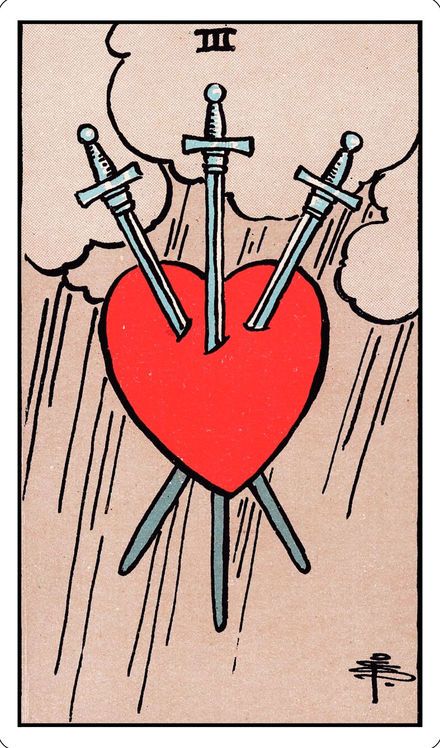
You will draw The Tower, or Death, or Three of Swords, and your stomach will drop. This is normal and it is worth handling deliberately rather than by immediately hunting for a gentler interpretation.
Notice the reaction first. The flinch tells you what you were hoping for, and knowing that changes how you read everything else in the spread. Then read the card as a response to your question rather than as a general prophecy. Death in response to “what is happening with my job” is not a warning about your health.
The difficult cards are usually describing something the person already knows. That is why they land so hard.
A reading you can do
- Write the question down in one sentence.
- Shuffle until it feels like enough. There is no correct method.
- Deal three cards, left to right: past, present, future.
- Say out loud what is literally in each picture before you interpret anything.
- Read them as one sentence. What moves? What does not?
- Answer the question you wrote down. Out loud, in a sentence.
Step six is the one people skip, and skipping it is how a reading turns into forty minutes of interesting observations that resolve into nothing.
Past, present, future is one set of positions and the easiest to start with. When a question wants a different shape, the tarot spreads here each set out what their positions ask and roughly how long they take, from one card to ten.
When to stop
If you keep pulling clarifying cards, you are shopping. If you have redealt the same question three times, you got your answer the first time and did not want it. If the reading has gone on for half an hour and you cannot say in one sentence what it told you, put the cards down.
A related thing worth knowing early, because it unsettles people: one card turning up over and over is mostly the deck rather than a message. Repeated tarot cards has the odds and the small number of repeats that are worth taking seriously.
Tarot is unusually good at showing you a situation from an angle you would not have chosen. It is not good at making a decision on your behalf, and readings go wrong most often when someone is quietly asking it to.
Common questions
- Do I need to memorize all 78 cards to read tarot?
- No, and trying to is the slowest route in. Learn the four suits and what each one governs, learn the numbers roughly, and look the rest up while you read. Meanings you look up while holding a real question stick far better than meanings you studied from a list.
- Do I have to believe in tarot for it to work?
- No. Plenty of people read tarot as a structured way of thinking about a situation from angles they would not have chosen, which works whether or not anything mystical is happening. The cards are good at interrupting the story you are already telling yourself.
- How do I read a card I do not like?
- Slowly, and without immediately looking for a softer interpretation. The flinch is information. Note that you had it, then read the card as an answer to the question you asked rather than as a prediction about your life. Difficult cards are usually describing something you already know.
- Should I use reversals when I start?
- Not at first. Learning 78 upright meanings is enough for a while, and adding reversals doubles the material before you have the basic skill of reading cards together. Add them once the upright meanings feel like knowledge rather than lookup.
Cards mentioned
There is also a page on what Reflecta is, if the waitlist is a step too early.