Major Arcana · 14
Temperance
- balance
- moderation
- patience
- purpose
Temperance points to finding the right balance, slowly. It means moderation, patience, and combining things that do not obviously go together. Upright it favors the middle path and a long timeline, and it often follows a period of extremes. Reversed it points to imbalance, impatience, or a compromise that has quietly become a way of avoiding things.
- Element
- Fire
- Astrology
- Sagittarius
- Numerology
- 14, the number of careful blending
- Yes or no
- yes
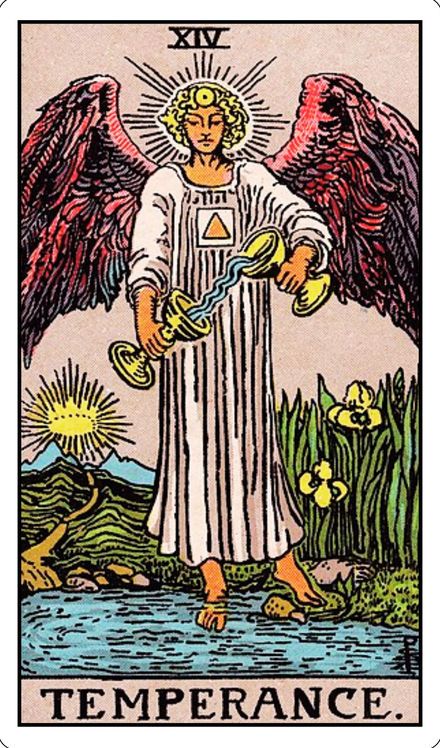
The water is going sideways. Look at the two cups: the stream between them flows at an angle no liquid could, and the figure pouring it is completely calm.
That angle is the point of the card. Waite says the figure has one foot on the earth and one on the water. Things that should not mix are being blended here, without strain or drama, and at a pace that would test anyone’s patience.
Temperance upright meaning
Finding the balance that works, slowly and by small adjustments.
Temperance comes right after Death in the deck, and that order looks deliberate. It is the card of what happens after something ends: the unglamorous work of putting what is left back together in a shape that works. Waite said the name means it tempers, combines, and harmonizes the inner and material natures. His meanings were economy, moderation, frugality, management, and accommodation. Its method is adjusting. How much of each? You test it over time. The card shows up when you are pulled toward an extreme: all in or all out, total discipline or giving up completely, cutting someone off or forgiving everything. It refuses both and asks for something harder: a balance you keep fine-tuning. That is less satisfying than a decision, but it works. It also covers slow recovery: from a breakup, a loss, or a period of overdoing something. Its hope is real, and it keeps its own timeline. If it has one suggestion, it is this: the thing you are trying to force to a conclusion may need adjusting instead.
Temperance reversed meaning
Imbalance, impatience, or a compromise that became avoidance.
Reversed, Temperance describes balance gone wrong. Waite's reversed meanings were disunion, unfortunate combinations, and competing interests, along with matters of churches and the priesthood. Something has taken over. Work has eaten the rest of your life, one relationship has absorbed all your attention, or a habit is no longer occasional. The card is not dramatic about this. It just notes that the mix is off, and that you may already know which part is causing it. The second reading is impatience, and it is the more common one. Something that needs time is being rushed, and the rushing can be what breaks it. Recovery gets pushed, a relationship moves too fast, or a business grows before it works. A third reading hides well: compromise as avoidance. Upright, Temperance is active blending. Reversed, it can turn into splitting every difference to avoid conflict. Nothing ever gets chosen, and moderation becomes a refusal to take a position.
A reversal is rarely the upright card's opposite. Reversed tarot cards covers the four conditions a reversal usually describes, and how to tell which one a spread is asking for. Every card's reversed meaning sits beside its upright one on reversed tarot card meanings.
Temperance in Waite's 1910 key
The meanings above are Reflecta's reading. These are the ones A. E. Waite gave in The Pictorial Key to the Tarot (1910), the guide he wrote for the deck Pamela Colman Smith drew. He wrote them for fortune-telling, a use tarot took on centuries after it began as a card game in fifteenth-century Italy. Some of his words are blunt, and none of them can tell you what will happen.
- Upright
- Economy, moderation, frugality, management, accommodation.
- Reversed
- Things connected with churches, religions, sects, the priesthood, sometimes even the priest who will marry the Querent; also disunion, unfortunate combinations, competing interests.
Symbolism in the card
- Water poured between two cups
- Waite describes an angel pouring the essences of life from chalice to chalice. The water flows at an angle that should be impossible. That is the quiet joke of the card. Things that should not mix are being blended, calmly.
- One foot in the water, one on land
- Waite says the figure has one foot on the earth and one on the waters. It stands in both at once and does not pick one. The card describes holding a position in two places, instead of ending the tension by choosing a side.
- The path leading to a crown between hills
- Waite describes a path going up to the heights, with a crown seen faintly in a great light. A long road to something worth reaching, drawn small and far away. The card is honest that the middle path is slower. It does get there, and the goal is a long way off.
Temperance in love and relationships
Upright. A relationship finding a balance that works: how much time together, how much space, and whose life bends where. The card favors patience and small adjustments over big talks. It is a good card for making up after a hard time.
Reversed. An uneven mix, where one person gives far more than the other, or a relationship rushed through stages it has not earned. It can also point to two people avoiding every disagreement, so nothing real ever gets settled.
Temperance in career and work
Upright. A pace you can sustain, people who work differently collaborating well, and steady progress. Strong for anything that combines different things: teams, skills, or a career built from several parts.
Reversed. Overwork, or a role where the balance has tipped and stayed that way. It can also point to a project pushed to a deadline the work cannot meet.
Temperance in money
Upright. Moderation you can sustain: room in the budget, and spending in line with earning. Nothing dramatic. The card favors the plan you can keep doing. The details are for you and your numbers.
Reversed. Spending in feast and famine cycles, or a budget so strict it keeps collapsing. The card asks whether the extreme plan is the real problem, and not a lack of discipline.
Temperance as feelings
Upright. As feelings, Temperance describes something settled and unhurried. It is steady more than intense, and happy to grow at its own pace. Undramatic, and one of the most lasting pictures in the deck. The card cannot confirm another person's heart. Patience in how they act is the better evidence.
Reversed. Reversed, it can describe feelings out of balance either way: too much too fast, or held back so carefully that nothing is risked. It may also point to waiting for perfect conditions. The card cannot answer for anyone else, and your own needs still count.
Is Temperance a yes or a no?
Upright, it leans yes. Reversed, it leans no.
Upright it leans yes, at its own pace: yes, gradually, and rarely if you rush it. The card favors the outcome but resists a fast timeline. Reversed it leans no. Often something is out of balance, or impatience could spoil something that only works slowly. Read the leaning as a note about pace. The decision is yours.
Every card's leaning in one table, upright and reversed, is on yes or no tarot, along with what a maybe is asking you to do.
Temperance as a birth card
661 of the 36,890 dates between 1925 and 2025, 1.8% of them, give Temperance as a first birth card, and it never arrives on its own. 14 reduces to 5, so The Hierophant is always the card underneath it.
Which card is yours comes from your birthday rather than from the deck. The tarot birth card calculator runs the reduction on a date of birth and shows every step of it. The date stays in the browser.
Temperance card combinations
- +Temperance and Death
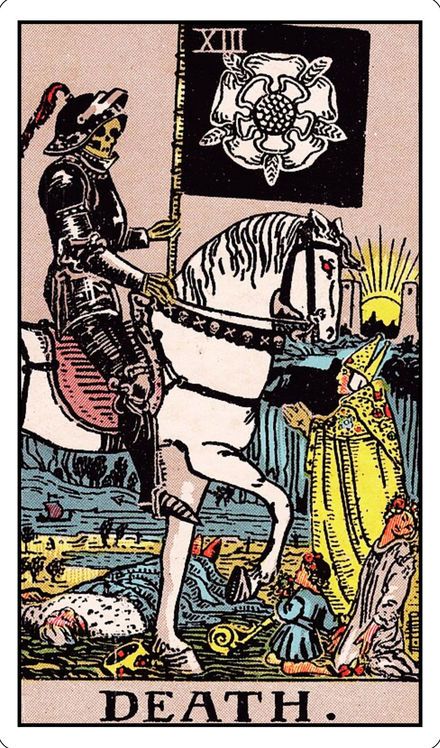
- The two cards the deck puts in order. An ending, followed by the slow work of rebuilding from what is left. Together they paint a truer picture of recovery than either card alone.
- +Temperance and The Devil
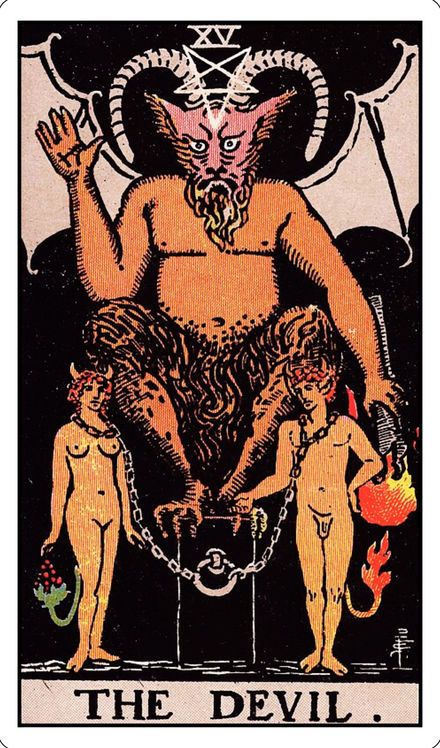
- Moderation against compulsion. Often a reading about a habit, and a hopeful one. Temperance is one of the few cards that answers The Devil without force.
- +Temperance and The Star
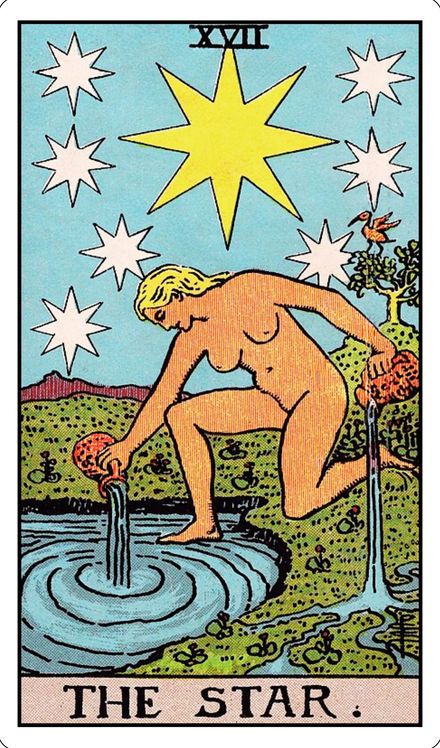
- Healing from two directions. Together they point to recovery underway. Temperance supplies the method, and The Star supplies the hope that makes the method bearable.
- +Temperance and The Chariot
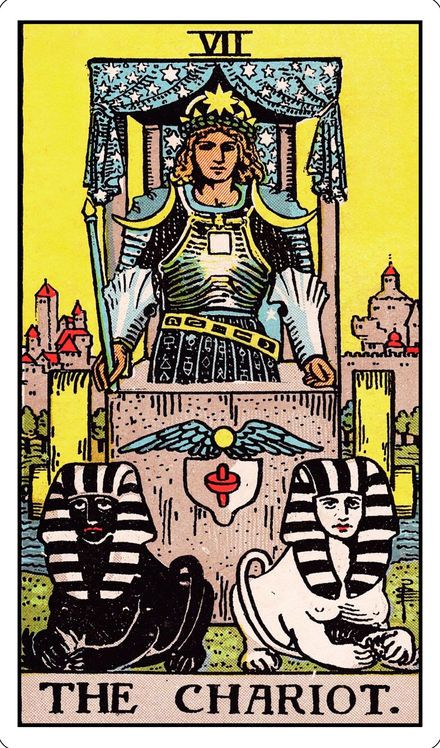
- A tension worth reading closely. The Chariot wants speed and force, and Temperance wants balance and time. Together they often suggest pushing has gone as far as it can, and the rest needs patience.
Every pairing on this site, Temperance's included, is collected on tarot card combinations.
I can find the proportion that works without rushing it.
Temperance: common questions
- What does Temperance mean in tarot?
- It points to finding the right balance, slowly. Temperance covers moderation, patience, and combining things that do not obviously go together. Waite's meanings were economy, moderation, and management. Upright it favors the middle path and a long timeline. Reversed it points to imbalance, impatience, or compromise that has become a way to avoid taking any real position.
- Is Temperance a good card?
- Yes, a quiet one. It often appears after a period of extremes or an ending, and points to recovery, a sustainable pace, and things settling into a shape that works. Its only difficulty is that it refuses to be rushed, which frustrates people who want results sooner.
- What does Temperance mean in love?
- A relationship finding a balance that works: how much time and space each person needs, and whose life bends where. It favors small adjustments over big talks, and it is a good card for making up. Reversed it points to uneven give and take, or to things being rushed.
- Why does Temperance come after Death?
- Because it describes what happens next. Death ends something, and Temperance is the slow work of rebuilding what is left into something that works. As a pair, they give a fairly accurate picture of recovery: the ending is fast, and the rebuilding is slow.
There is also a page on what Reflecta does with a reading once the cards are down.