Three card tarot reading examples
Four complete three card readings follow, each with a question, three named cards, and what the reading came to. The method is the same every time: read each card for the position it landed in rather than in general, read the three pairs against each other, then say in one sentence what the reading came to. One of the four settles nothing, which is a normal outcome and the reason it is included.
Search for an example of a three card tarot reading and you will find the layout. Past, present, future, a diagram with three rectangles, and then an interpretation section that is usually The Fool, The Magician and The World with one invented sentence each and no relationship between them.
That is a lookup with a diagram over it, and it is the whole first page of results, because a worked reading cannot be produced at volume. It needs somebody to sit down with three specific cards and a real question and be willing to be wrong in public.
So here are four. Each one has a question, three cards, each card read for the position it landed in, what the three pairs say, and what it came to. They are deliberately different from each other: a decision, a person, a pair of cards that disagree, and one where the honest answer is that nothing was settled.
How these were built, so you can discount them properly
The per-position reads are written for these spreads. The lines under what the pairs say are not written here at all: they are read out of the card pages, where the pairings for two cards drawn together were written one at a time, long before this page existed and without knowing which spread they would end up in.
That matters for the only reason a page like this can be trusted. The usual failure of a worked example is that the cards were picked to make the point, and the way to check is whether the commentary on a pair would still be the same commentary somewhere else. Here it is, because it is the same sentence, served from the same place, on the card’s own page.
What is not guarded is the choice of triples. These four were chosen from the spreads where the deck already had something to say about all three pairs, so they are not random draws and this page does not pretend they are. Treat them as worked examples rather than as evidence about how often the cards land well.
One: a decision that turns out to be already made
The question. What am I really deciding about this job?
The positions, from the job set in tarot spread positions, on the three card layout.
1 The job as it is
2 What goes
3 What comes too
- What the job is, as opposed to how it was described
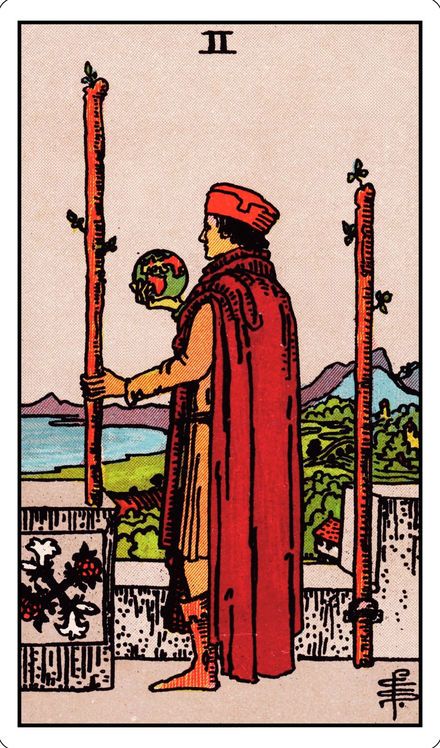
- Two of Wands. Somewhere secure, with a view out. This is not a card about a bad job, and that is the first thing the spread does: it refuses the framing that you are escaping something. You are standing on a wall looking at the horizon, and the wall is holding you up fine.
- What I would be giving up
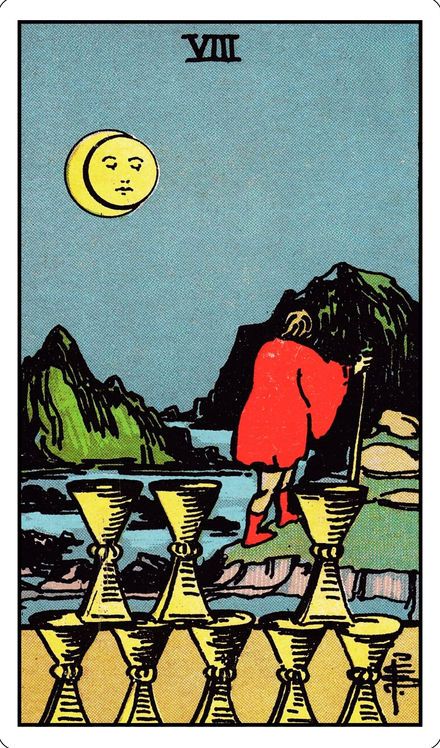
- Eight of Cups. Something that is not broken. The Eight of Cups is the deck being specific about a particular kind of leaving, the kind where nothing has gone wrong and you go anyway. What you would give up is a thing you would struggle to justify giving up, which is why the decision has taken this long.
- What I would still be carrying afterward
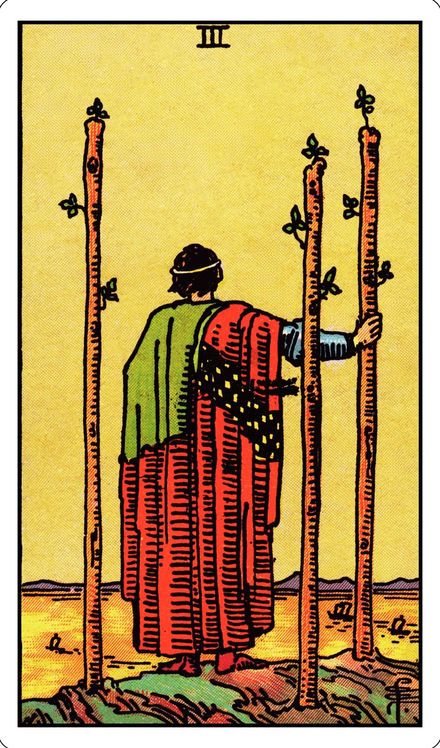
- Three of Wands. The waiting. Watching for something you have already set in motion is a posture, and postures travel. This is the position that earns the spread, because it is the one a list of pros and cons cannot produce.
What the pairs say
- Two of Wands and Eight of CupsTwo cards about leaving something that is fine. Together they lean firmly toward going. Both agree that nothing is wrong with what you would leave behind.
- Two of Wands and Three of WandsThe plan, and then carrying it out, in the deck's own order. Together they suggest the decision may already be made and the thing already underway.
- Eight of Cups and Three of WandsThe point where waiting turns into leaving. Together they ask how long the horizon has been empty, and they are gentle if the answer is long enough.
What it came to. The leaving is mostly decided. The waiting goes with you.
Two of the three pairs say the same thing from different angles, which is as firm as three cards get. The third pair is the useful one: the horizon has been empty long enough, and the Three of Wands is in the position about what survives the move. The spread agrees with the decision and then declines to flatter it. Leaving may change the view and leave the habit of scanning it intact.
Notice what is missing. Nothing here says the new job will be better, because no position asked. That is the discipline: the reading answers the three questions it was dealt and stops.
Two: a person, and the reading is not about them
The question. What is going on between me and the colleague I keep clashing with?
The cards have never met your colleague, so a spread that promises to explain them is selling something. These positions ask about the part you can see.
1 The friction
2 What I want
3 The other route
- What the friction is about, as opposed to what we argue about
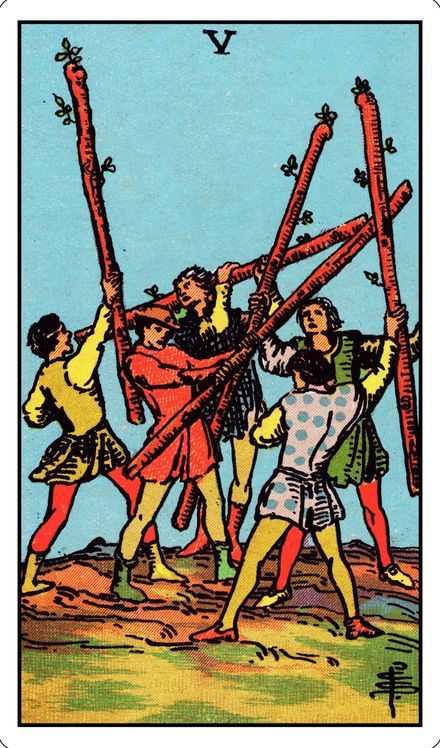
- Five of Wands. A scrum with nobody real to fight in it. The Five of Wands has no enemy in it, only five people swinging staves at cross purposes and hitting nothing. In this position it says the clash is structural. You are both pushing in a space too small for two.
- What I am trying to get out of it
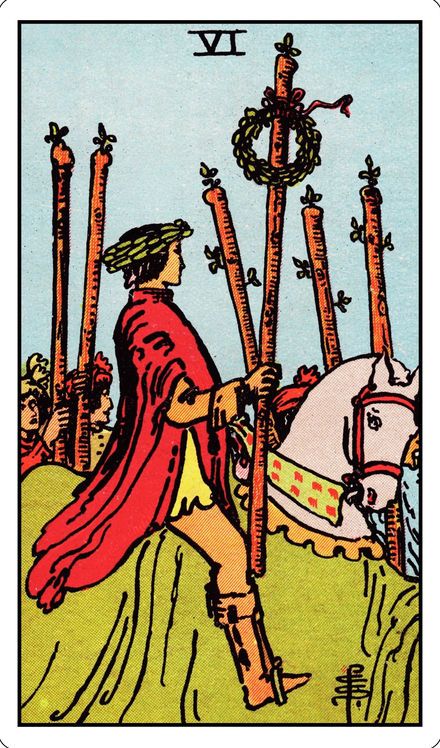
- Six of Wands. To be seen winning. This is the position most people would rather skip, and the card does not soften it: the Six of Wands is a victory with an audience, and the audience is the point.
- What the two of us would be doing if it were not this
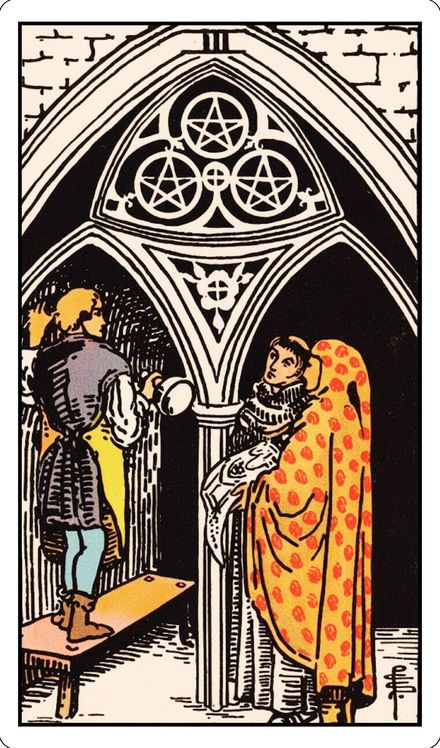
- Three of Pentacles. Building something, and being watched doing it. The Three of Pentacles is skilled work recognized while it happens, which is the same recognition the second card wants, arriving by a different road.
What the pairs say
- Five of Wands and Six of WandsThe contest, then the result, in the deck's own order. Together they suggest the scuffle may end, with something to show for it.
- Five of Wands and Three of PentaclesClashing effort next to teamwork that works. The contrast is the reading: the same people could be building something together.
- Six of Wands and Three of PentaclesSkill, and recognition for it. It often points to good work finally being noticed by people whose opinion counts.
What it came to. You want the same thing from both routes, and one of them is far more expensive.
The reading turns on the second and third cards being about the same need. Once you see that, the first card stops being a complaint about a person and becomes a description of a room. The spread never says your colleague is difficult, and refusing to say it is the most useful thing it does.
The uncomfortable part is position two, and it is uncomfortable because it was written to be. A position you would rather not answer is the one carrying the reading; a set of positions that leaves you feeling reasonable throughout was built to.
Three: two cards that disagree
The question. I have been pushing on this for months and it will not move. What is the pushing missing?
1 What I do
2 What is asked
3 If I keep going
- What I am doing now
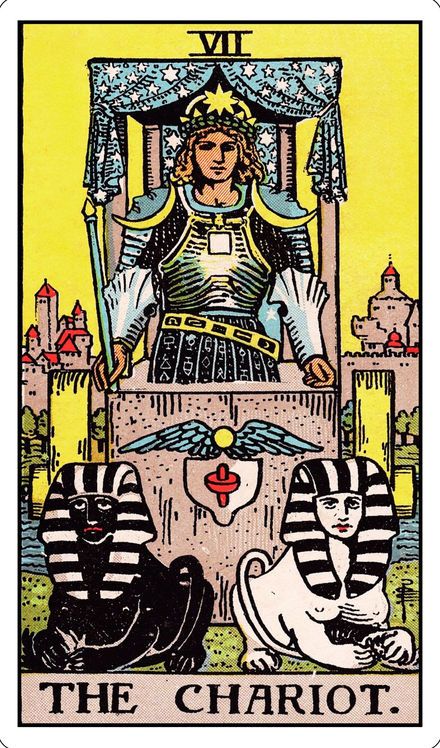
- The Chariot. Forward motion held together by will. The Chariot works, and it works by holding two things that want to go different ways and refusing to let them. That is the method under the last few months, described without judgment.
- What the situation is asking for
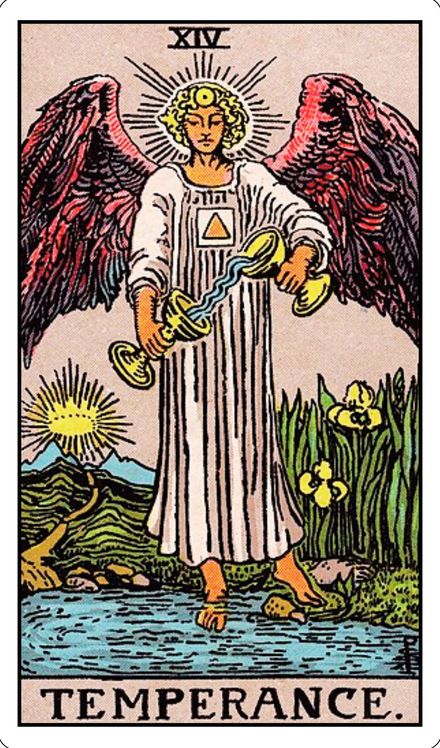
- Temperance. Proportion, found slowly and by adjustment. Temperance is the deck at its least dramatic and its most specific: the answer is a mixture, and mixtures are arrived at by testing rather than by force.
- What happens if I keep doing the first thing
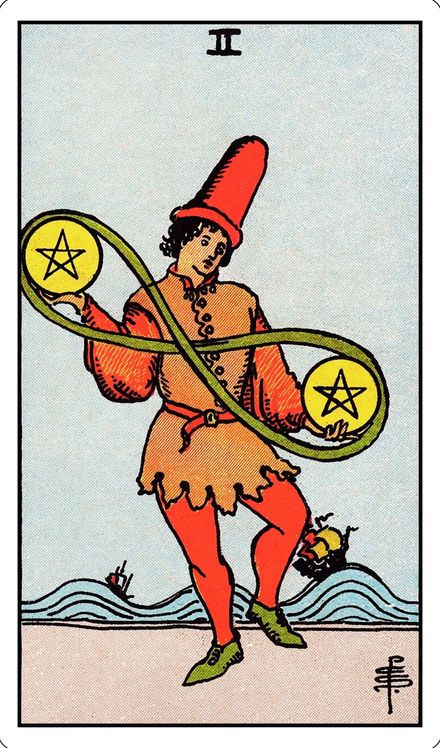
- Two of Pentacles. More things in the air, and the whole arrangement dependent on you not blinking. Something short of collapse, more ordinary and more tiring: a version that works exactly as long as your attention holds out.
What the pairs say
- The Chariot and TemperanceA tension worth reading closely. The Chariot wants speed and force, and Temperance wants balance and time. Together they often suggest pushing has gone as far as it can, and the rest needs patience.
- The Chariot and Two of PentaclesHolding opposing forces together, twice. It points to real ability under strain, and notes that the whole arrangement depends on constant attention.
- Temperance and Two of PentaclesBalance through movement, next to balance through proportion. Usually it means the juggling has a version you can sustain. Finding it means changing the mix, more than moving faster.
What it came to. More force is unlikely to move it, and pushing was never the mistake.
This is the shape people mean when they say a reading contradicted itself. The Chariot and Temperance want opposite methods and the deck knows it. The mistake is to split the difference and read it as push a bit less, which is what an averaged reading always produces and is advice nobody can act on.
The third card breaks the tie, and this is the general move: when two cards disagree, one of them is usually describing the situation and the other is describing you, and the third position tells you which is which. Here the Chariot is the method and Temperance is the situation, and the Two of Pentacles shows what the method buys if it continues. Pushing less misses it too. The spread points toward changing the mixture, which is a different action entirely.
Four: a reading that settles nothing
The question. Should I tell them?
1 What it is about
2 What holds it
3 What I would need
- What this decision is really about
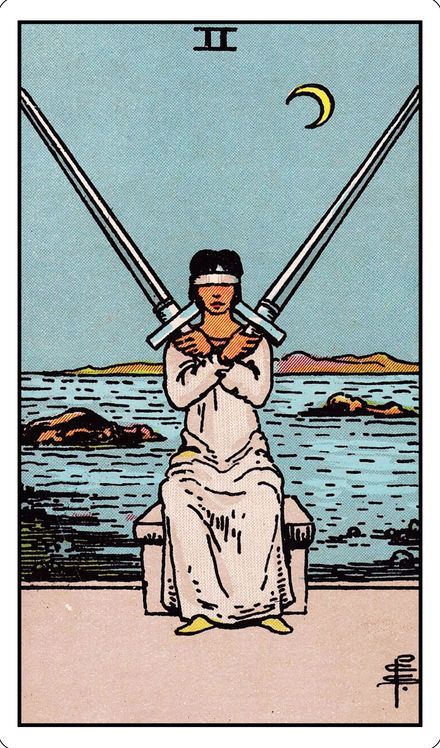
- Two of Swords. A choice being held off by not looking at it. The blindfold on this card is tied on from the inside. In this position it says the decision is not hard so much as unexamined, and those feel identical from where you are sitting.
- What is keeping me in it
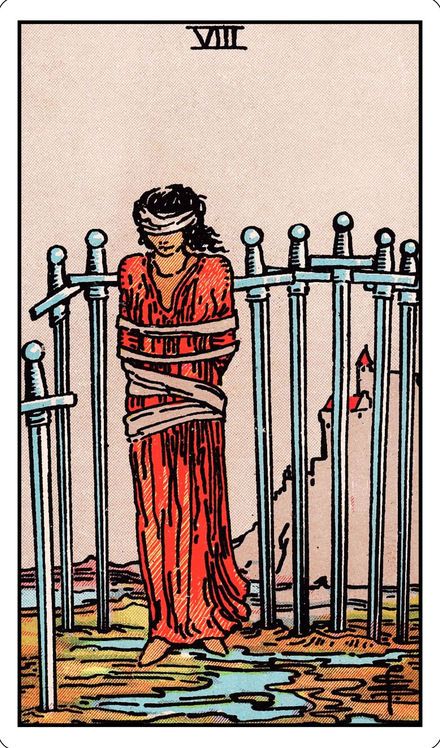
- Eight of Swords. A bind that is looser than it feels. The figure is loosely tied, the swords have a gap, and the card is about the difference between being trapped and believing you are. What holds this in place is a sense of having no room.
- What would have to be true for me to decide
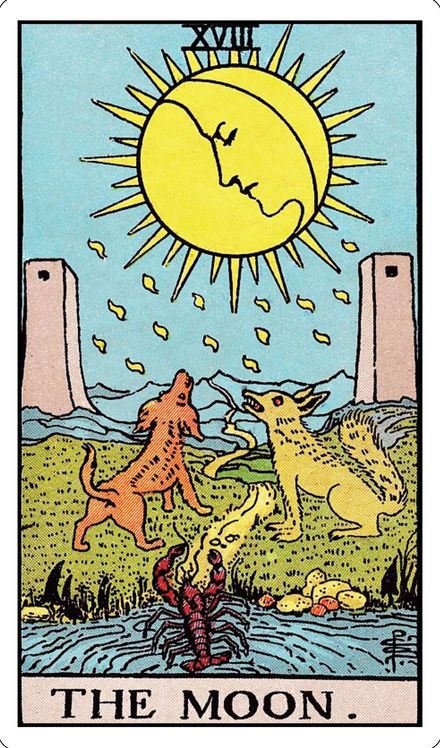
- The Moon. Sight you do not have yet. The Moon is the one card in the deck that answers a question by declining it, and in this position it declines cleanly: the conditions for a decision are not present.
What the pairs say
- Two of Swords and Eight of SwordsTwo cards about limits you put on yourself. Both describe binds that are mostly in the mind. Together they suggest the situation is far less fixed than it feels.
- Two of Swords and The MoonNot looking, next to not seeing clearly. Together they lean against deciding now, and suggest giving the fog time to lift.
- Eight of Swords and The MoonLimits and warped perception together. Heavy, and hopeful. Both cards describe limits that are mostly in the mind, and both loosen when you look at them directly.
What it came to. Nothing, and that is the finding.
All three cards say a version of the same thing, and so do all three pairs. Two of them go further and locate the constraint: the bind is largely mental and the fog is partly your own. So the reading is less comfortable than the wait for clarity this spread usually gets read as. It is closer to: there is no decision available today, some of the reason is you, and the deck cannot tell you which part.
I have included this one because every page of examples leaves it out, and leaving it out is dishonest about what the cards do. A deck that answers every question is a deck whose answers are worth nothing, and the times a spread declines are what make the times it does not worth having. If you deal three cards on something and get this, the better response is to stop and deal again in two weeks rather than squint at the row until it yields. Look at the question too. A yes or no leaves three cards very little to describe, and what is making this hard to say? would have given them more.
The method, in four steps
Every reading above was built the same way, and none of it requires knowing the deck well.
- Ask something a card could answer. Not the timing, not what somebody else will do. Something you are doing, avoiding, or carrying. The positions guide has the test and the failure modes.
- Read each card for its position. The Three of Wands in the position about what you carry forward is a different card from the Three of Wands as an outcome. This is the step that separates a reading from a lookup, and it is where how to read tarot spends most of its argument.
- Read the three pairs. Three cards make three pairs and the pairs carry more than the cards do. Two cards agreeing is firmer than either alone; two disagreeing is the most informative thing in the spread. Every card page on this site lists what that card says next to the ones it is most often drawn with.
- Say what it came to, in one sentence, before you decide how you feel about it. Then keep the sentence. A reading you wrote down is the only kind you can check later against what happened, which is the difference between getting better at this and getting more confident at it. Keeping that record is most of what the Reflecta app does: the spread, the question and what you said about it, still there in six months when you want to see what it was pointing at.
Reversals change none of this. If you use them, the card reads differently and the method is identical, and reversed tarot cards covers which of the four conditions a reversal is describing.
Common questions
- What is an example of a three card tarot reading?
- A complete one has four parts: a question narrow enough to answer, three cards each read for the position it landed in, what the pairs of cards say about each other, and what it came to, in one sentence. The four on this page are worked in that order. A reading that stops after the three card meanings is a lookup rather than a reading, which is the form almost every example online takes.
- How do you interpret three tarot cards together?
- Read each card for its position first, then read the three pairs. Three cards make three pairs, and the pairs are where the reading is: two cards about leaving say something firmer than either one alone, and two cards that disagree tell you the situation and your method are pulling in different directions. Finish by saying what the row came to in one sentence you would be willing to be wrong about.
- What do you do when two tarot cards contradict each other?
- Do not average them. A contradiction is usually one card describing the situation and the other describing what you are doing about it, and the third card tells you which is which. The third reading on this page is exactly this: The Chariot wants force and Temperance wants proportion, and the Two of Pentacles decides between them by showing what the forcing produces.
- Can a tarot reading have no answer?
- Yes, and a deck that never declines a question is a deck whose answers are worth nothing. The fourth reading here is three cards that all say the same thing, which is that there is not enough information yet and some of the fog is being supplied by the person asking. That is a finding in its own right.
- How do I know if I am reading the cards or telling myself what I want?
- Write down what the reading came to before you decide how you feel about it, then read it again a few weeks later. The test is whether a reading ever tells you something you did not want to hear. If every spread you deal agrees with you, the cards are not the thing doing the work, and the fix is to write the positions as questions you would rather not answer.
Cards mentioned
There is also a page on what Reflecta is, if the waitlist is a step too early.