5 of Wands
Five of Wands
- competition
- conflict
- tension
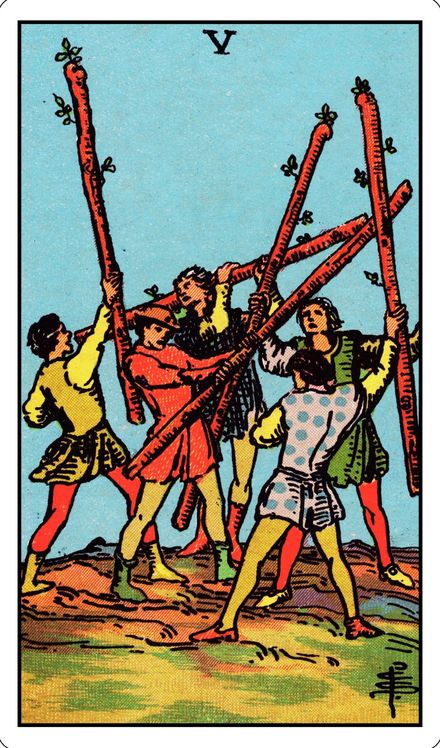
The Five of Wands means friction without a real enemy. Five young men wave staves at each other in what looks more like a game than a battle. Waite called it mimic warfare. The card covers competition, disagreement, and several people wanting different things at once. As a yes or no it leans maybe: the thing is still up for grabs, so the answer depends on how much you want to compete for it. Reversed it leans no: the fight has turned personal, or it is being avoided.
- Element
- Fire
- Astrology
- Saturn in Leo
- Numerology
- 5, the number where the stable four is disturbed
- Yes or no
- maybe
Nobody is hitting anybody. Look closely at the staves: they cross in the air, held up, missing each other completely.
Five people in five different outfits, in clear daylight, on open ground, making a lot of noise. It is less a battle than the sound of a room where everyone came in wanting something slightly different.
Most situations that draw this card are five people talking past each other. Two real opponents are rare.
Five of Wands upright meaning
Friction, with nobody real to fight against.
The Five of Wands shows five young men waving staves in the same patch of ground. Nobody is being hit. There are no teams, no two are dressed alike, and the sky is clear. It reads more like a game than a battle. Waite called it mimic warfare, a sham fight, and also the hard competition of chasing money and success. That is the specific quality of the card: conflict that is messy, more than dangerous. In readings it covers competition, clashing opinions, a project with too many people who each want something different, and the noise of several agendas in one room. It is tiring, and it is no disaster. There is a useful version too: the argument that makes the work better. The card is usually describing that, more than a war. Its practical advice is to find out what everyone wants. Most Five of Wands situations are five people talking past each other, more than two sides in a real fight.
Five of Wands reversed meaning
Conflict avoided, or a fight that turned personal.
Reversed, the Five of Wands goes two ways. The first is avoidance. The disagreement is real, and nobody will have it. So the friction goes underground and comes out as quiet resistance, missed deadlines, and meetings where everyone agrees and nothing changes. The card is fairly clear that the useful argument is the one being skipped. The second reading is worse: the scuffle turning into something with sharp edges. Competition becomes personal, rivalry stops being about the work, or the group hardens into two camps. Waite's reversed meanings point the same way: lawsuits, disputes, trickery, and contradiction. At that point it has moved into Five of Swords territory. There is also a quieter reading about pulling out of a contest. That can be good judgment, or it can mean giving up something you wanted. The card does not say which.
A reversal is rarely the upright card's opposite. Reversed tarot cards covers the four conditions a reversal usually describes, and how to tell which one a spread is asking for. Every card's reversed meaning sits beside its upright one on reversed tarot card meanings.
Five of Wands in Waite's 1910 key
The meanings above are Reflecta's reading. These are the ones A. E. Waite gave in The Pictorial Key to the Tarot (1910), the guide he wrote for the deck Pamela Colman Smith drew. He wrote them for fortune-telling, a use tarot took on centuries after it began as a card game in fifteenth-century Italy. Some of his words are blunt, and none of them can tell you what will happen.
- Upright
- Imitation, as, for example, sham fight, but also the strenuous competition and struggle of the search after riches and fortune. In this sense it connects with the battle of life. Hence some attributions say that it is a card of gold, gain, opulence.
- Reversed
- Litigation, disputes, trickery, contradiction.
Symbolism in the card
- The staves crossing without connecting
- Waite describes youths brandishing staves as if in sport or strife. None of the wands is hitting anyone. It is closer to a scuffle than a fight, and that sets the tone of the whole card.
- Five figures in five different tunics
- No two are dressed alike, and there are no teams. Everyone is in it for themselves. That is why it creates noise and no result.
- The clear sky and open ground
- Good weather, plain daylight, and nothing at stake in the landscape. The card puts the disorder in the people. The circumstances are fine.
Five of Wands in love and relationships
Upright. Petty friction, more than serious conflict: bickering, competing for attention, or two people who both want to be right about small things. Tiring, and rarely fatal.
Reversed. Disagreements nobody will say out loud, or bickering that has developed an edge. The first can turn into the second if it goes on long enough.
Five of Wands in career and work
Upright. A competitive workplace, a crowded field, or a project where too many people want different outcomes. The card favors competing openly instead of maneuvering behind the scenes.
Reversed. Conflict everyone is avoiding, or rivalry that has turned personal. It can also mean pulling out of a contest you could probably have won.
Five of Wands in money
Upright. Competing for something limited: a budget, a contract, or a bid. The card favors making your case, instead of assuming your merits will speak for themselves. Waite noted that some read it as a card of gain.
Reversed. A money dispute that goes quiet without ever being settled, or competition over money that damages a relationship that was worth more.
Five of Wands as feelings
Upright. Conflicted, and a bit combative. The card can describe interest that refuses to make things easy, or friction that someone enjoys more than they would admit. Only the person can say which.
Reversed. A disagreement being avoided, or a resentment not yet raised. In this card, what looks like calm is often something being stored up. The card cannot say what.
Is Five of Wands a yes or a no?
Upright, it leans maybe. Reversed, it leans no.
Upright it sits at maybe. The thing is still being contested and nothing is settled, so the answer depends on how much you want to compete for it. Reversed it leans no, often because the conflict has turned personal, or because it is being avoided and left unresolved.
Every card's leaning in one table, upright and reversed, is on yes or no tarot, along with what a maybe is asking you to do.
Five of Wands card combinations
- +Five of Wands and Five of Swords
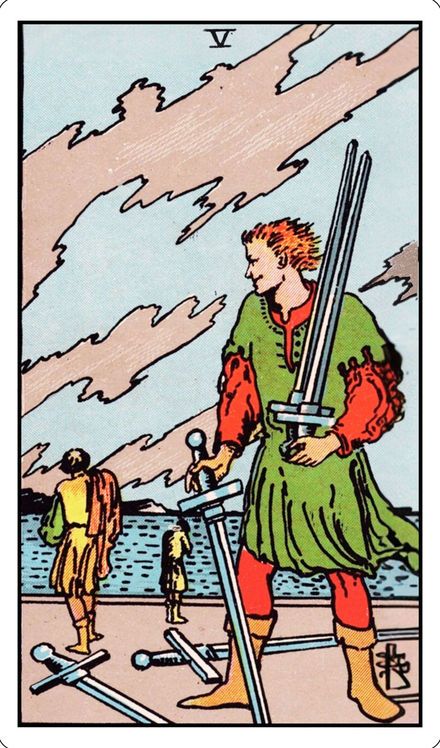
- Messy friction next to a fight with a winner. Together they can mark the moment a scuffle turns into something that costs someone.
- +Five of Wands and Seven of Wands
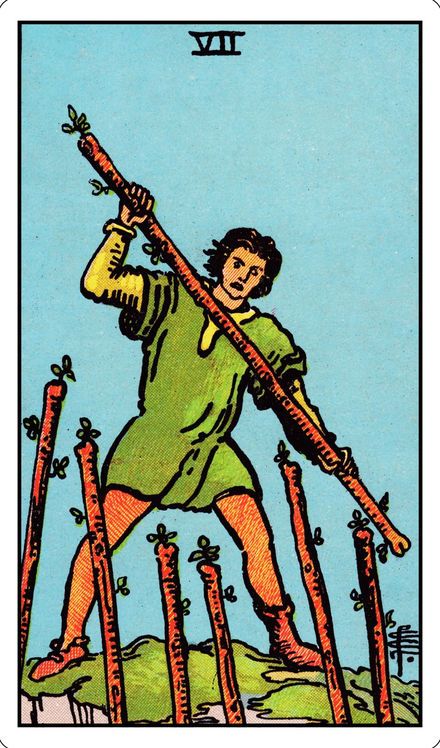
- Competition, then defending your position. A strong sequence. The contest may end with you holding ground you have won, which is more focused than the scuffle.
- +Five of Wands and Three of Pentacles
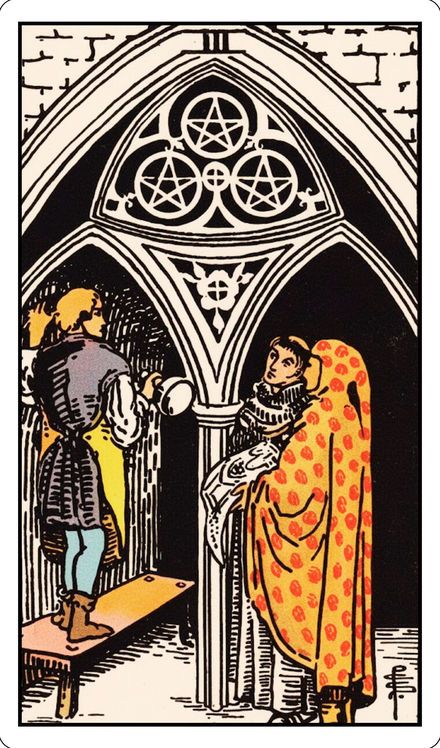
- Clashing effort next to teamwork that works. The contrast is the reading: the same people could be building something together.
- +Five of Wands and Temperance
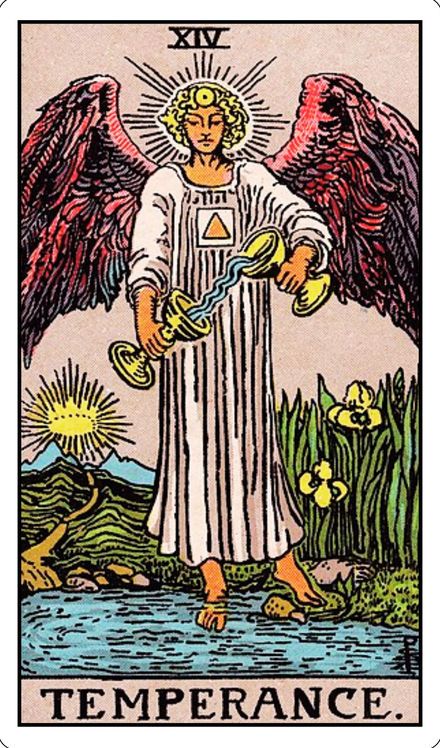
- Noise meets balance. It often suggests the disagreement is smaller than it feels, and may settle through blending ideas instead of anyone winning.
Every pairing on this site, Five of Wands's included, is collected on tarot card combinations.
Some friction here is part of the work.
Five of Wands: common questions
- What does the Five of Wands mean?
- It means friction without a real enemy. Five figures wave staves in the same space, and nobody gets hit. Waite called it mimic warfare. It covers competition, clashing opinions, and several agendas in one room. That is tiring, more than dangerous.
- Is the Five of Wands a serious conflict?
- Usually not. The card is careful about this: no two figures are dressed alike, there are no teams, and none of the staves lands a blow. It looks more like a game than a battle. When conflict becomes serious, it has moved into Five of Swords territory.
- What does the Five of Wands mean in love?
- Petty friction, more than a real problem: bickering, competing for attention, or both people wanting to be right about small things. Reversed it points to disagreements nobody will voice. That is how the small version develops an edge.
- What does the Five of Wands reversed mean?
- Either conflict being avoided, so the friction goes underground and comes out as quiet resistance, or the scuffle hardening into something personal. Waite's reversed meanings were lawsuits, disputes, trickery, and contradiction. It can also mean pulling out of a contest, which the card does not judge either way.
There is also a page on what Reflecta does with a reading once the cards are down.