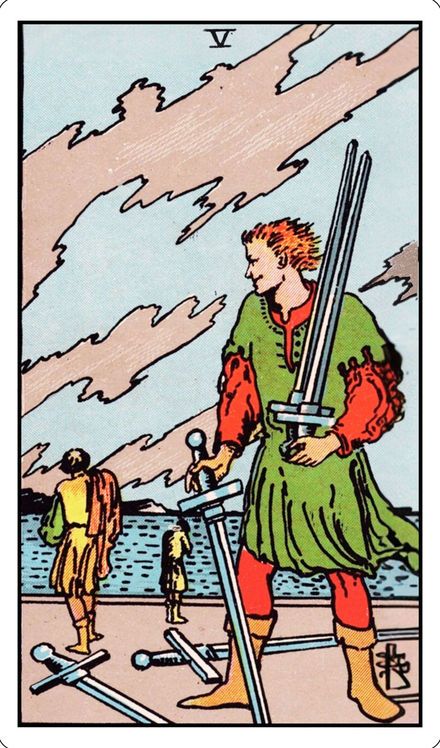
5 of Swords
Five of Swords
- conflict
- defeat
- hostility
The Five of Swords means a win that costs more than it was worth. One man gathers up swords while two others walk away, and you may be any of them. Waite's meanings were harsh: degradation, dishonor, and loss. As a yes or no it leans no, and the no is about cost. You might win this, and winning could damage something you wanted to keep. Reversed it sits at maybe, because a fight ending can mean repair or retreat.
- Element
- Air
- Astrology
- Venus in Aquarius
- Numerology
- 5, the number where a fixed structure breaks open
- Yes or no
- no
He is picking up the swords, and his face is doing something that is not quite a smile.
Two people walk away with their backs to him. He has the field, the weapons, and the argument. The picture is arranged so that what he lost takes up the bigger part of it.
The sky behind them is torn, still unsettled. Nothing has been settled here.
Five of Swords upright meaning
A win that costs more than it was worth.
The Five of Swords is the card of the empty win. A man gathers up the swords with a look that is not quite triumph, while two others walk away with their backs turned. Something has been won, and the field is empty. Waite's meanings were among the harshest in the deck: degradation, destruction, cancellation, disgrace, dishonor, and loss. The card's real skill is leaving open which figure you are. Most people assume they are one of the ones walking away. The reading is often more useful if you consider that you might be the one holding the swords. In practice it covers arguments won at the cost of the relationship, being right in a way that helped nothing, and fights that were never worth winning. It also covers being on the losing side of that, which is its own kind of humiliation. Its question is nearly always about cost. What would winning this get you? The card suggests it may be less than you think.
Five of Swords reversed meaning
The fight ending, or the start of repair.
Reversed, the Five of Swords usually means the conflict is over. Sometimes that is real reconciliation: an apology made, a grudge let go, or a relationship repaired after a stretch of point-scoring. That is the good reading, and it is real. The less good version is withdrawal. The fighting stops because someone left, and nothing was settled. The disagreement underneath is still fully there. A third reading is the aftermath of an empty win: the realization, usually late, that being right was not worth what it cost, and the wish to take back something already said. Waite saw no relief in the reversal. He gave the same meanings, with burial and funerals added. Many modern readers are gentler with it, and see repair as possible, often for whoever is willing to go first.
A reversal is rarely the upright card's opposite. Reversed tarot cards covers the four conditions a reversal usually describes, and how to tell which one a spread is asking for. Every card's reversed meaning sits beside its upright one on reversed tarot card meanings.
Five of Swords in Waite's 1910 key
The meanings above are Reflecta's reading. These are the ones A. E. Waite gave in The Pictorial Key to the Tarot (1910), the guide he wrote for the deck Pamela Colman Smith drew. He wrote them for fortune-telling, a use tarot took on centuries after it began as a card game in fifteenth-century Italy. Some of his words are blunt, and none of them can tell you what will happen.
- Upright
- Degradation, destruction, revocation, infamy, dishonor, loss, with the variants and analogues of these.
- Reversed
- The same; burial and obsequies.
Symbolism in the card
- The man gathering the swords
- Waite calls him disdainful, the master of the field. He carries two swords on his shoulder and holds a third pointing at the ground. He has what he fought for, and the picture gives him no joy in it.
- The two figures walking away
- Waite describes two figures retreating, beaten and dejected, their swords left on the ground. They lost the argument. He lost their company, and the card treats that as the bigger loss.
- The ragged clouds overhead
- The sky is torn and unsettled. The conflict has changed the conditions without clearing them. Nothing has really been settled.
Five of Swords in love and relationships
Upright. An argument that damages the relationship, point-scoring, or being right at the other person's expense. It also covers the slow damage done to a couple who fight to win.
Reversed. Making up after conflict, or a fight ending because one person walked away. Worth working out which, because they lead to very different places.
Five of Swords in career and work
Upright. Office conflict, a colleague who competes instead of cooperating, or winning an argument at work in a way that costs you everyone's goodwill. It can also mean being on the receiving end of that.
Reversed. A conflict at work settling, or leaving a situation instead of continuing to fight. Both are endings, and only one is a repair.
Five of Swords in money
Upright. Money won in a dispute at a higher cost than the amount, or a money argument damaging a relationship. Legal fees often belong here. Waite's extra meanings included an attack on your fortune.
Reversed. A money dispute settling, or deciding the money is not worth the fight. The card treats that as sensible, and rarely satisfying.
Five of Swords as feelings
Upright. Defensive, with a combative edge: a sense of being wronged, and more interest in proving it than in fixing anything. While that lasts, the conversation is hard to win.
Reversed. A readiness to stop fighting. That can mean a willingness to repair, or giving up on the argument entirely. Only what happens next will show which.
Is Five of Swords a yes or a no?
Upright, it leans no. Reversed, it leans maybe.
Upright it leans no, specifically about cost. You may well be able to win this, and winning could damage something you wanted to keep. Reversed it sits at maybe, because it usually describes a conflict ending. That can mean real repair, or just withdrawing, and those turn out very differently.
Every card's leaning in one table, upright and reversed, is on yes or no tarot, along with what a maybe is asking you to do.
Five of Swords card combinations
- +Five of Swords and Two of Cups
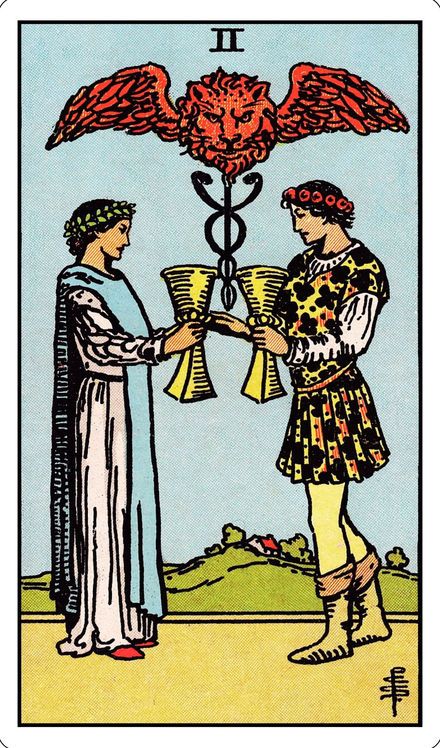
- A real connection with a destructive pattern inside it. Usually a relationship that is real, with a way of fighting that costs more than either person admits.
- +Five of Swords and Justice
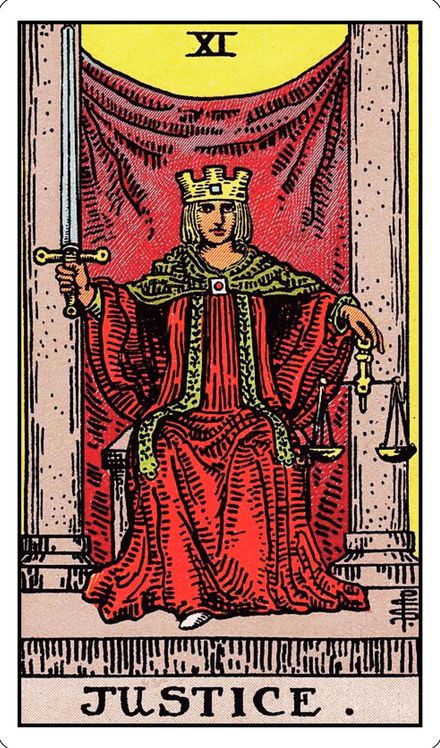
- Conflict next to fairness. Often it means the fight is happening on unfair terms, or that being technically right will not lead to a fair outcome.
- +Five of Swords and Six of Swords
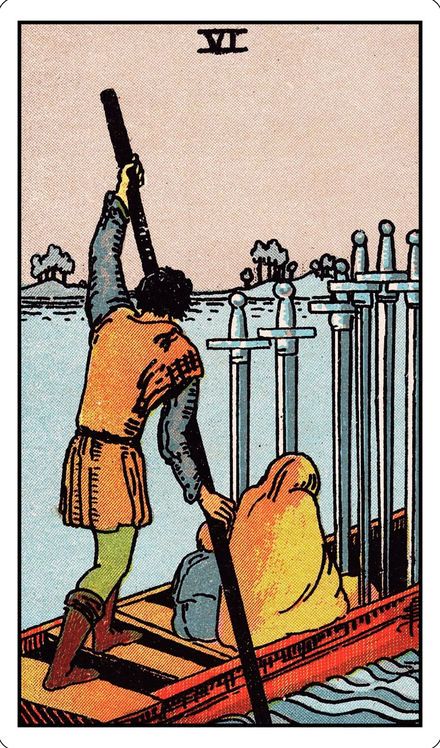
- Conflict, then leaving, in the deck's own order. Together they ask whether walking away would serve you better than winning this fight even more completely.
- +Five of Swords and The Tower
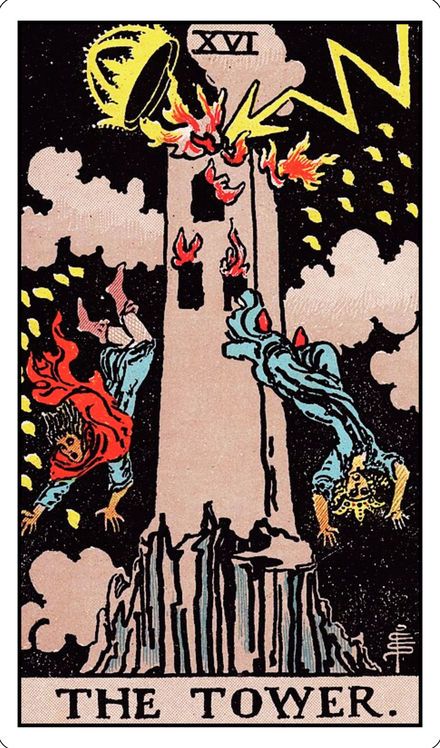
- A conflict that breaks something big. Usually the argument was only the trigger, and the collapse was already waiting. That does not make the argument harmless.
Every pairing on this site, Five of Swords's included, is collected on tarot card combinations.
I would rather be in this relationship than be right.
Five of Swords: common questions
- What does the Five of Swords mean?
- It means a win that costs more than it was worth. One man gathers the swords with a look that is not quite triumph, while two others walk away. Waite's meanings were degradation, dishonor, and loss. It covers arguments won at the expense of the relationship they happened in.
- Am I the winner or the loser in the Five of Swords?
- The card leaves it open on purpose. The reading is usually more useful if you consider that you might be the one holding the swords. Most people assume they are one of the figures walking away. That is the more comfortable assumption, and not always the accurate one.
- What does the Five of Swords mean in love?
- An argument that damages the relationship, point-scoring, or being right at the other person's expense. It describes the slow damage done to a couple who fight to win. Reversed it points to making up, or to a fight ending because someone left.
- Is the Five of Swords always about conflict?
- Almost always, though the conflict can be quiet. It covers competitiveness, one-upmanship, and the slow damage of a relationship where being right matters more than being together, as much as a real argument.
There is also a page on what Reflecta does with a reading once the cards are down.