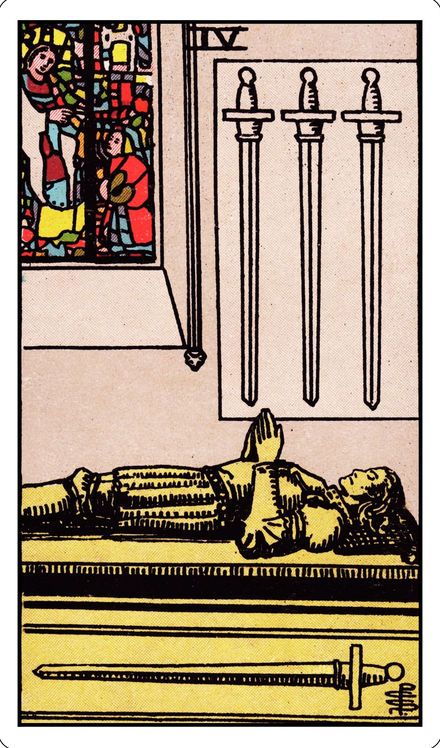
4 of Swords
Four of Swords
- rest
- recovery
- contemplation
The Four of Swords means rest you need. A knight lies still on a tomb, hands together in prayer, with swords above him and beside him. It covers recovery, retreat, and deliberately stopping your thinking for a while. Waite's meanings were retreat, solitude, and a hermit's rest. Upright it favors stopping before you are forced to. Reversed it points to resisting rest, or a recovery period ending and activity starting again.
- Element
- Air
- Astrology
- Jupiter in Libra
- Numerology
- 4, the number of what is fixed and still
- Yes or no
- no
He lies on a tomb like a stone figure, hands together in prayer. That is why this card can frighten people at first glance.
Look at the swords. Three hang above him, pointing down, clear of his body. One lies beside him, put down. Nothing has been solved. He has simply stopped, in a quiet place, with the problems still overhead and out of his hands.
Four of Swords upright meaning
Rest that you need, more than rest you indulge in.
The Four of Swords shows a knight's stone figure lying full length on a tomb, hands together in prayer, with swords above him and beside him. It is one of the few cards in the deck whose whole message is to stop. Waite's meanings were watchfulness, retreat, solitude, a hermit's rest, and exile. He said the tomb in the picture came from the old meanings of tomb and coffin. In modern readings the card is about rest. It usually appears after a hard period, more than during one. Its subject is recovery: getting better, taking a break, or deliberately stepping back from thinking about something. The suit matters here. Swords are the mind, so this is mental rest: setting down a problem you have been turning over nonstop. The three swords still hang above him, unresolved. That is the honest part. Rest does not require the problems to be solved first. It requires you to put them down for a while. The card leans hard on this, and on the difference between choosing to stop and being made to stop.
Four of Swords reversed meaning
Rest resisted, or a recovery period ending.
Reversed, the Four of Swords goes two ways. The more common one is refusing rest: pushing on when stopping is what you need, managing burnout instead of recovering from it, or being unable to keep still for so long that it has become a pattern. The card does not lecture. It notes that rest tends to arrive anyway, and asks whether you will take it or have it forced on you. Its second, more positive reading is a recovery period ending on its own. Someone who has been resting, healing, or keeping to themselves is ready to return. The reversal marks activity starting again, and no failure to rest. That version usually appears after the upright card has been showing up for a while. Waite's reversal pointed somewhere practical: careful management, caution, thrift, and also stinginess and making a will. There is also a smaller reading about restlessness during forced stillness, where your body has stopped and your mind has not agreed to.
A reversal is rarely the upright card's opposite. Reversed tarot cards covers the four conditions a reversal usually describes, and how to tell which one a spread is asking for. Every card's reversed meaning sits beside its upright one on reversed tarot card meanings.
Four of Swords in Waite's 1910 key
The meanings above are Reflecta's reading. These are the ones A. E. Waite gave in The Pictorial Key to the Tarot (1910), the guide he wrote for the deck Pamela Colman Smith drew. He wrote them for fortune-telling, a use tarot took on centuries after it began as a card game in fifteenth-century Italy. Some of his words are blunt, and none of them can tell you what will happen.
- Upright
- Vigilance, retreat, solitude, hermit's repose, exile, tomb and coffin. It is these last that have suggested the design.
- Reversed
- Wise administration, circumspection, economy, avarice, precaution, testament.
Symbolism in the card
- The knight lying in prayer on his tomb
- Waite describes the effigy of a knight, lying full length on his tomb with his hands in prayer. It is a stone figure at rest. The card borrows that stillness. It is about stopping, and Waite's meanings make that clear.
- The three swords hanging above him
- Three swords hang above him, pointing down and not touching him. The difficulties are still there, hanging unresolved. That is exactly what real rest looks like.
- The single sword lying beside him
- One sword lies along the tomb beside him. Something has been put down on purpose. It is not lost. It is resting with him.
Four of Swords in love and relationships
Upright. A relationship taking a deliberate pause, or needing space from thinking about one. The card favors stepping back more than settling things. It does not mean an ending.
Reversed. Coming back to a relationship after a break, or refusing the space that would help. It can also mean starting to date again after a quiet period.
Four of Swords in career and work
Upright. A break from work, sick leave, or a project deliberately put on hold. The card strongly favors taking the time, and it shows up most for people sure they cannot.
Reversed. Going back to work after time off, or pushing through a time when you need to stop. The second can turn into the first, without your choosing.
Four of Swords in money
Upright. A pause in money activity: no new commitments, no decisions, letting things sit. It can also mean money spent on recovery, which the card treats as sound.
Reversed. Money activity picking up after a quiet period, or being unable to stop spending or earning long enough to see where you stand. Waite read careful management and thrift into the reversal.
Four of Swords as feelings
Upright. Pulling back to think. The card does not read that as rejection. It describes a need for quiet, and chasing someone during a pause like this tends to make it longer. The rest is theirs to say.
Reversed. Coming back after a period of distance, or being unable to give the situation the space it needs. Someone's availability may be shifting, one way or the other.
Four of Swords in a reading position
The same card answers differently depending on what the position asked it. These are the readings for the positions people ask about most.
Four of Swords as timing
The timing systems disagree with each other. One counts Wands as days and Swords as weeks, the astrological decans give a different answer, and reading the card number as a count of weeks gives a third. No single one of them is the tradition, so what follows is read from the picture instead, which can tell you pace even when it cannot tell you a date.
Upright. A pause with an end to it. The knight is resting, and the three swords still hang unresolved. So this reads as a stretch of weeks when nothing gets decided and nothing needs to be.
Reversed. The pause is ending, or it was never taken. Reversed, either recovery is finishing and activity resumes soon, or the rest was refused and may arrive later, at a worse moment.
Four of Swords as reconciliation
Upright. Probably not now, and the delay may be the kind part. The card asks you to put the problem down, more than solve it. A conversation during this period would be between two people with nothing left in reserve.
Reversed. Someone is ready to talk before the rest has done its work. Reversed, the return is rushed, and the argument tends to pick up where it left off, with nothing new.
Is Four of Swords a yes or a no?
Upright, it leans no. Reversed, it leans yes.
Upright it reads as no, in the sense of not now. The card leans toward recovery over action, so anything that takes effort may be badly timed. Reversed it leans yes, since it usually describes the rest ending and the energy for activity coming back.
Every card's leaning in one table, upright and reversed, is on yes or no tarot, along with what a maybe is asking you to do.
Four of Swords card combinations
- +Four of Swords and The Hanged Man
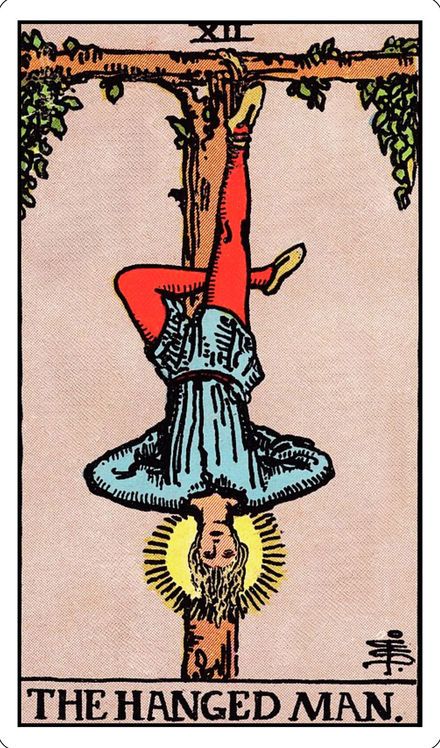
- Two cards about pausing, and neither will be hurried. Together they make about as firm a case for stopping as the deck can.
- +Four of Swords and Nine of Swords
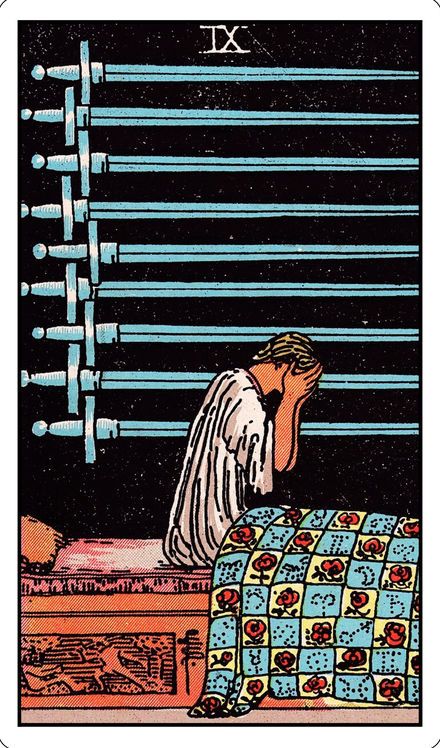
- Rest next to sleepless worry. Usually it means you need the rest and your mind will not cooperate. That is a specific, common state.
- +Four of Swords and The Hermit
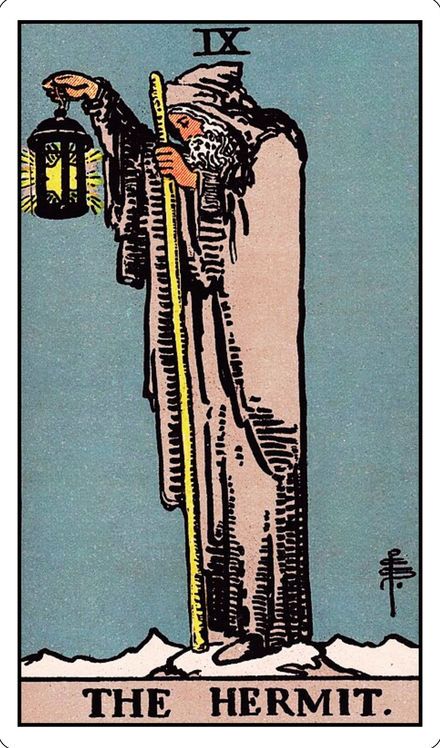
- Withdrawing, twice: once to recover and once to understand. Together they favor a long stretch out of contact, and suggest it may be useful.
- +Four of Swords and The Star
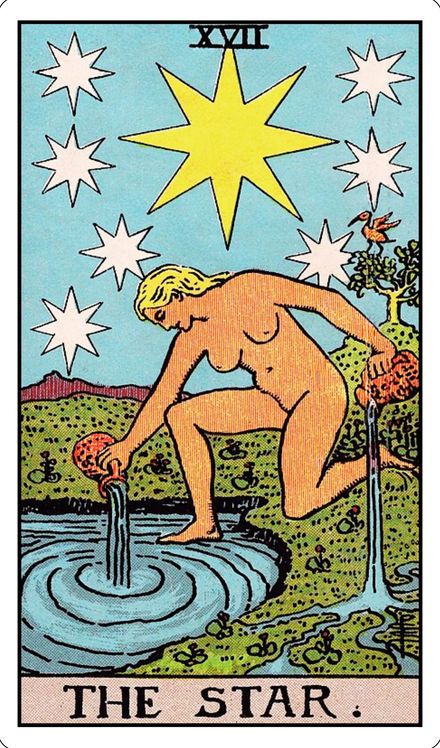
- Rest, then renewal. A gentle pairing. It suggests the recovery is working, and that something which had run out is filling back up.
Every pairing on this site, Four of Swords's included, is collected on tarot card combinations.
Stopping is part of the work.
Four of Swords: common questions
- What does the Four of Swords mean?
- It means rest you need. A knight lies still on a tomb, with swords above him and beside him. It covers recovery, retreat, and deliberately stepping back from thinking. Waite's meanings were retreat, solitude, and a hermit's rest. It usually appears after a hard period, more than during one.
- Does the Four of Swords mean death?
- No. Tarot cannot predict a death. Waite described the picture as a stone effigy of a knight on his tomb, and that is why the card can unsettle people. But the meanings he gave were retreat, solitude, and rest. It is one of the few cards whose whole message is to stop.
- What does the Four of Swords mean for health?
- Recovery, and the need for rest, often mental more than physical, since this is the suit of the mind. It favors taking the time. The card can help you think about rest. It cannot assess your health. That belongs with a doctor. Reversed it points to rest being refused, or to a recovery period ending on its own.
- Why are three swords still hanging above him?
- Because the problems are hanging unresolved, and they are not solved. That is the honest part of the card. Rest does not require you to deal with the problems first. It requires you to put them down for a while. They will still be there afterward.
There is also a page on what Reflecta does with a reading once the cards are down.