6 of Swords
Six of Swords
- transition
- moving on
- leaving behind
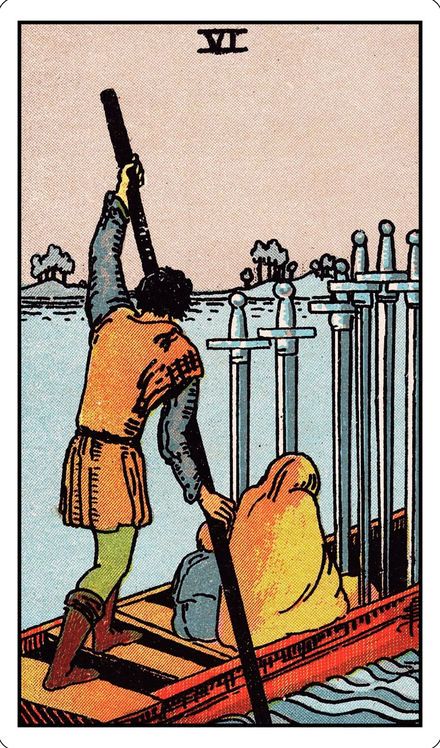
The Six of Swords means moving toward calmer water, carrying what happened with you. A ferryman steers a boat to the far shore, with a hooded passenger, a child, and six swords aboard. Waite's meanings were travel by water, a route, and a way through. Upright it is a change that feels necessary, gradual, and sad. Reversed it points to leaving that keeps not happening, or leaving without settling anything.
- Element
- Air
- Astrology
- Mercury in Aquarius
- Numerology
- 6, the number of passage and crossing
- Yes or no
- yes
Look at the water. On one side of the boat it is rough and choppy. On the other it is almost flat. The boat is right in the middle of that change.
The passenger is hooded, facing away from where they are going. Nobody in this picture looks relieved, and the direction still looks like the right one.
The six swords stand upright in the boat, coming along for the crossing.
Six of Swords upright meaning
Moving to calmer water, carrying what happened.
The Six of Swords is one of the most emotionally honest cards in the deck. A ferryman steers a small boat toward the far shore, with a hooded passenger and a child aboard, and six swords standing upright in the boat. Things are getting better, and nobody is happy. That combination is what makes the card useful. Most talk about things improving assumes relief, and this card does not. Waite's meanings were travel by water, a route, a way, a messenger, and a practical solution. He noted that the course is smooth and the load light. In readings it covers moving on after a hard period, leaving a situation, real travel and moving house, and slowly coming out of grief. The most important detail is that the swords come along. The card does not pretend you leave the difficulty behind. You are moving somewhere it is easier to bear. It leans toward going anyway. This card offers no neat resolution. If you wait to feel good about the move before you make it, you may never make it.
Six of Swords reversed meaning
A departure that keeps on not happening.
Reversed, the Six of Swords usually means the change is stuck. A move that seems overdue is not happening: a job not left, a city not moved to, or a relationship you have been leaving in theory for most of a year. Often the person putting it off knows this better than anyone. Its second reading is leaving without dealing with anything, so the situation rebuilds itself in the new place: the same job at a different company, or the same relationship with a different person. The swords come along either way. The reversal is about the difference between carrying them and being carried by them. Waite's reversed meanings were different again: a declaration, a confession, something made public, and in one account a proposal of love. There is also a simpler version: resisting a necessary change. The boat is right there, and getting in feels like admitting the old thing failed.
A reversal is rarely the upright card's opposite. Reversed tarot cards covers the four conditions a reversal usually describes, and how to tell which one a spread is asking for. Every card's reversed meaning sits beside its upright one on reversed tarot card meanings.
Six of Swords in Waite's 1910 key
The meanings above are Reflecta's reading. These are the ones A. E. Waite gave in The Pictorial Key to the Tarot (1910), the guide he wrote for the deck Pamela Colman Smith drew. He wrote them for fortune-telling, a use tarot took on centuries after it began as a card game in fifteenth-century Italy. Some of his words are blunt, and none of them can tell you what will happen.
- Upright
- Journey by water, route, way, envoy, commissionary, expedient.
- Reversed
- Declaration, confession, publicity; one account says that it is a proposal of love.
Symbolism in the card
- The six swords standing upright in the boat
- The swords come along. Nothing is left behind or thrown overboard. That is the card's realism: you take the difficulty with you, and go somewhere it weighs less.
- The ferryman and the smooth course
- Waite describes a ferryman taking passengers to the far shore. He says the course is smooth, the load is light, and the work is not too much for him. The crossing is manageable.
- The hooded passenger with a child
- The passenger is covered up and turned away from where they are going. The card puts the sadness of leaving in the same picture as the improvement.
Six of Swords in love and relationships
Upright. Leaving a relationship, or getting through the aftermath of one. It tends to be gradual and sad, and still headed somewhere that feels right. It can also mean a couple getting through a hard patch together, toward calmer ground.
Reversed. A breakup that never quite happens, or leaving one relationship and immediately recreating it. Waite read the reversal as a confession, or even a proposal of love.
Six of Swords in career and work
Upright. Leaving a job, changing fields, or going through a career transition. The card favors going, and it does not promise the going will feel good.
Reversed. A resignation put off indefinitely, or a new job that turned out to be the old job again. Worth working out which, before you move again.
Six of Swords in money
Upright. Moving toward financial stability after a hard stretch. Slow improvement more than a windfall, and the debts come along with you.
Reversed. A financial transition that has stalled, or a fresh start that has brought back the old habits. The habits are usually what to address, more than the numbers.
Six of Swords as feelings
Upright. Feelings that may be moving on, quietly and without drama, with no anger or indecision in the picture. The card describes feelings fading, more than ending, and a direction that points away.
Reversed. Trying to move on and not managing it, or leaving without resolving anything. The feelings in this card are unfinished in a way that tends to travel with you.
Six of Swords in a reading position
The same card answers differently depending on what the position asked it. These are the readings for the positions people ask about most.
Six of Swords in the past position
Upright. A crossing already made, and the swords came along. What still shapes things is the difficulty you brought with you, more than the water you left. This card is honest about that.
Reversed. A departure that kept not happening, or one made without settling anything, so the situation rebuilt itself in the new place. The same job at a different company is the usual version.
Six of Swords in the present position
Upright. You are in the middle of the water, still crossing. Things are getting better, and nobody is happy. This position is both of those at once.
Reversed. The boat is there, and getting in feels like admitting the old thing failed. The move may feel overdue, and the person putting it off often knows that best.
Six of Swords in the future position
Upright. Calmer water, slowly, with everything still on board. The card does not promise resolution ahead, only a place where the same weight is easier to bear. It leans toward going anyway.
Reversed. If nothing changes, the crossing may not happen. Leaving in theory for a whole year is the specific trap this card names, and it is the future here that is easiest to change.
Past, present and future are the three positions of the three card tarot spread, which explains why the past card is read as a cause and the future card as a direction of travel that can still change.
Is Six of Swords a yes or a no?
Upright, it leans yes. Reversed, it leans no.
Upright it leans toward a qualified yes. The direction looks sound, but it may not feel like a triumph. It is a yes about direction, more than about mood. Reversed it leans no, often because the move has stalled, or because leaving now would bring the whole situation along.
Every card's leaning in one table, upright and reversed, is on yes or no tarot, along with what a maybe is asking you to do.
Six of Swords card combinations
- +Six of Swords and Five of Swords
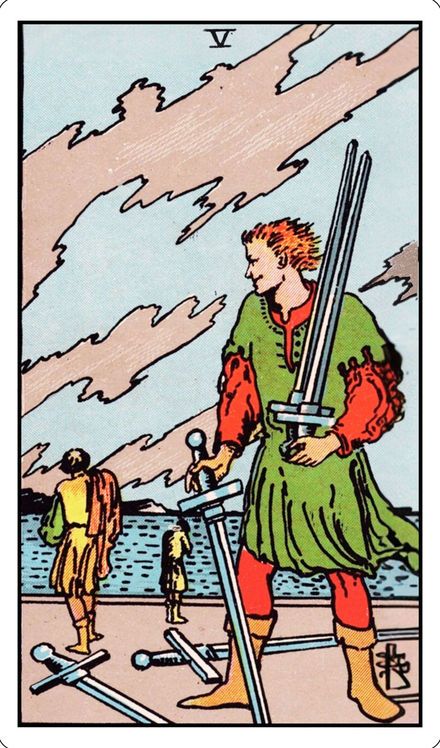
- Conflict, then leaving, in the deck's own order. Together they ask whether walking away would serve you better than winning the fight even more completely.
- +Six of Swords and Eight of Cups
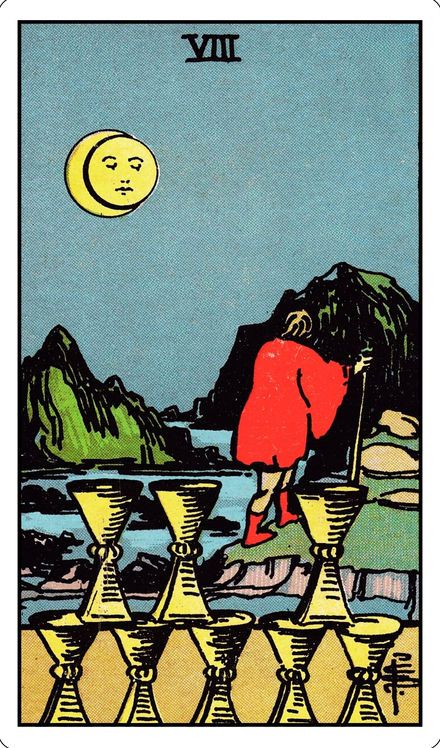
- Two departures, in different weather. The Eight leaves something intact, by choice. This one leaves something hard, by necessity. Together they mark a serious, deliberate exit.
- +Six of Swords and The Star

- A crossing into healing. A reassuring pairing. It suggests the calmer water is real, and that recovery may follow.
- +Six of Swords and The Hanged Man
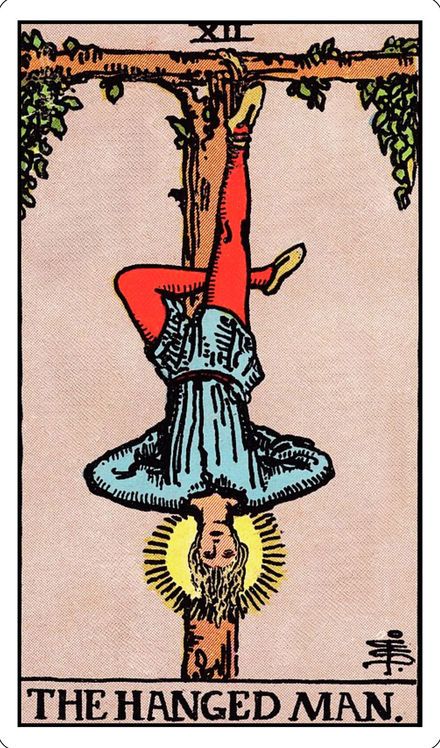
- Moving, next to pausing. Usually the reading is about whether it is time to go or time to wait. Together they favor going, once the pause has done its work.
Every pairing on this site, Six of Swords's included, is collected on tarot card combinations.
I can go somewhere calmer and still be sad about it.
Six of Swords: common questions
- What does the Six of Swords mean?
- It means moving toward calmer water while carrying what happened. A ferryman steers a boat to the far shore, with six swords standing in it. Waite's meanings were travel by water, a route, and a way through. Things are getting better, and nobody in the picture is happy. That is what makes it honest.
- Does the Six of Swords mean travel?
- Sometimes it means real travel, including moving house, and Waite's first meaning was travel by water. More often it means a transition in general: leaving a job, a relationship, or a hard period. The literal reading is stronger when other cards in the spread point that way.
- Why are the swords in the boat?
- Because they come along. It is the card's central realism: you move somewhere the difficulty weighs less, and you bring it with you. Nothing has been thrown overboard or solved. The card is honest that you have changed places, and you still have the same load.
- What does the Six of Swords reversed mean?
- Usually a transition that is stuck: a job not left, or a relationship you have been leaving in theory for months. It can also mean leaving without dealing with anything, so the situation rebuilds itself in the new place. Waite read it as a confession, or a proposal of love.
There is also a page on what Reflecta does with a reading once the cards are down.