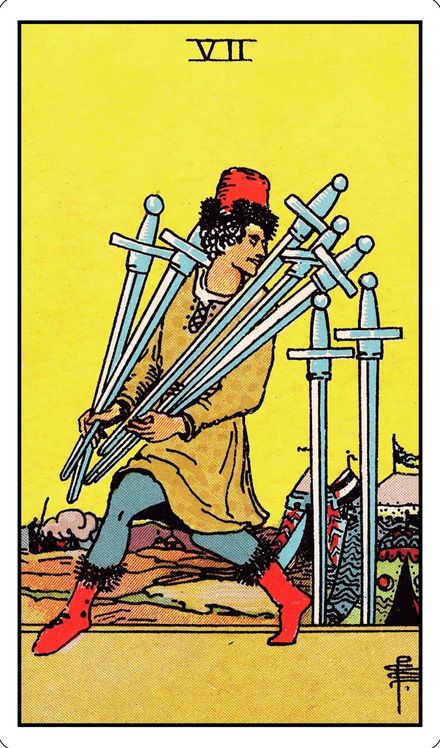
7 of Swords
Seven of Swords
- deception
- strategy
- cunning
The Seven of Swords means taking a shortcut you would rather not explain. A man hurries away from a camp with five swords, leaving two behind. Modern readers mostly see deception, strategy, and self-deception in it. Waite found it unclear and gave a scheme, an attempt, and a plan that may fail. Upright the card notes that the plan is incomplete. Reversed it usually means being caught, confessing, or dropping the scheme.
- Element
- Air
- Astrology
- Moon in Aquarius
- Numerology
- 7, the number of the clever and incomplete
- Yes or no
- no
He looks back over his shoulder while walking forward. It is an awkward way to move, and a very accurate way to draw this card.
Two swords still stand in the ground behind him. He could not carry all seven. So whatever he has just done is incomplete, and part of the evidence is staying exactly where it was, in plain sight of the camp.
Seven of Swords upright meaning
Taking a shortcut you would rather not explain.
The Seven of Swords is the card of getting away with it, and the picture makes the getting away look uncomfortable. A man hurries away from a camp with five swords, glancing back, leaving two standing in the ground. Waite himself called the card unclear, because its meanings point in very different directions. He listed a scheme, an attempt, a wish, hope, and confidence, and also quarreling, annoyance, and a plan that may fail. Modern readings mostly settle on deception, theft, strategy, and cutting corners. It is one of the few cards that can point to someone else deceiving you, though it cannot confirm it. Keep two things in mind. First, the plan is incomplete. He left two swords behind, so whatever is being got away with is likely only partial. Second, the card very often turns inward. It frequently describes self-deception: a quietly edited account of your own behavior, or a plan that only works if nobody looks closely. Its practical test is simple. Could you describe what you are doing to the person it affects?
Seven of Swords reversed meaning
Being caught, confessing, or dropping the scheme.
Reversed, the Seven of Swords usually ends the hiding. That can be discovery, where someone finds out. Or it can be confession, where the person carrying the swords puts them down because carrying them has become worse than the consequences. Both count, and the card is noticeably kinder to the second. Another reading is a plan dropped before it is carried out. That is often a good outcome, though it rarely feels like one. A third version is worth naming: getting away with something and finding it was not worth having. That is the specific emptiness of a shortcut that worked. The reversal can also point to returning what was taken, apologizing, or starting to repair things. Waite's reversed meanings were good advice, counsel, and instruction, and also slander and idle gossip.
A reversal is rarely the upright card's opposite. Reversed tarot cards covers the four conditions a reversal usually describes, and how to tell which one a spread is asking for. Every card's reversed meaning sits beside its upright one on reversed tarot card meanings.
Seven of Swords in Waite's 1910 key
The meanings above are Reflecta's reading. These are the ones A. E. Waite gave in The Pictorial Key to the Tarot (1910), the guide he wrote for the deck Pamela Colman Smith drew. He wrote them for fortune-telling, a use tarot took on centuries after it began as a card game in fifteenth-century Italy. Some of his words are blunt, and none of them can tell you what will happen.
- Upright
- Design, attempt, wish, hope, confidence; also quarrelling, a plan that may fail, annoyance. The design is uncertain in its import, because the significations are widely at variance with each other.
- Reversed
- Good advice, counsel, instruction, slander, babbling.
Symbolism in the card
- The two swords left standing behind him
- Waite describes a man carrying five swords away quickly, while the other two stay stuck in the ground. He could not carry all seven. It is a partial job. The two left behind are the part of the story that stays to be found.
- His backward glance while walking forward
- He looks back at the camp instead of where he is going. Anyone leaving like this spends the whole exit looking over their shoulder. That is most of the cost.
- The camp close at hand
- Waite notes a camp nearby. The tents are occupied, and nobody has noticed yet. The card is set in the gap between doing the thing and being found out.
Seven of Swords in love and relationships
Upright. Dishonesty in a relationship, something being hidden, or a story of events that has been edited. It can also mean keeping something to yourself for reasons you can defend.
Reversed. A deception coming to light, or someone confessing. It can also mean choosing honesty before you are forced into it, which is the version with a future.
Seven of Swords in career and work
Upright. Cutting corners, taking credit, or a workplace where information is being withheld on purpose. It can also mean a plan that only works if nobody looks at it too closely.
Reversed. Being found out, owning up, or dropping a shortcut and doing it properly instead. Usually the more expensive route, and the one that lasts. Waite read good advice into the reversal.
Seven of Swords in money
Upright. Cutting corners with money, something not declared, or an arrangement that would not look good written down. The incompleteness is the risk.
Reversed. A money deception coming to light, or putting an arrangement right on your own. Fixing it yourself costs much less than being found out.
Seven of Swords as feelings
Upright. Something held back. That could be strategy or self-protection, and the card cannot say which, only that the picture may be incomplete. Notice what someone's actions show, along with what they say.
Reversed. Honesty arriving, or something coming to light. The card describes a position becoming visible one way or the other. The difference is who brings it out.
Seven of Swords in a reading position
The same card answers differently depending on what the position asked it. These are the readings for the positions people ask about most.
Seven of Swords as someone's intentions
Upright. An intention to handle this without sharing all of it. The card cannot read minds, but it describes a plan that only works if nobody looks too closely. That may be strategy, or self-protection.
Reversed. An intention to come clean, or a realization that it may become unavoidable. Reversed, the hiding is ending. The rest of the spread may help show whether that looks like confession or discovery.
Seven of Swords as action
Upright. Strategy may work better than directness here, so check what the strategy costs. The card allows a shortcut, and points at the two swords left behind: whatever you take this way, you may only get part of it.
Reversed. Consider putting the swords down. The action may be to stop carrying it, return what was taken, or say it out loud. All of those usually cost less than the day someone else discovers it.
Seven of Swords as how someone sees you
Upright. Possibly as someone to be managed, more than met openly. The card describes being handled, which can reflect a belief that the whole picture would land badly. That belief may or may not be fair to you. Only actions can show it.
Reversed. Possibly as someone owed an explanation. The card describes a shift from working around you toward talking to you, and that talk has not happened yet.
Seven of Swords as an obstacle
Upright. The obstacle is a quietly edited version of events, and it is often your own. Ask whether you could describe what you are doing to the person it affects. The answer is the block.
Reversed. Exposure is the obstacle. What was hidden is coming into view. The difficulty ahead comes from the discovery, more than from the original shortcut.
Seven of Swords as an outcome
Upright. On the current path, someone gets away with something, but only partly. Five swords out of seven: the result tends to arrive incomplete, and the part left behind is often the part that mattered.
Reversed. This points toward everything coming into the open. The scheme is dropped, discovered, or confessed. The card is noticeably kinder to the version where the person carrying it chooses to stop.
Seven of Swords as advice
Upright. Think before you move, and do not mistake being clever for having a plan. Where this card allows the shortcut at all, it asks you to know exactly which two swords you are leaving behind.
Reversed. Consider telling the truth first, and early. A confession you make yourself is a smaller event than one made for you. The difference is who controls the timing.
Is Seven of Swords a yes or a no?
Upright, it leans no. Reversed, it leans maybe.
Upright it leans no, specifically about method. The approach involves hiding something, or a shortcut that may not hold up if anyone looks closely. Reversed it sits at maybe, because it usually means the deception is ending. That could be a confession, a discovery, or simply a better plan replacing a bad one.
Every card's leaning in one table, upright and reversed, is on yes or no tarot, along with what a maybe is asking you to do.
Seven of Swords card combinations
- +Seven of Swords and The Moon
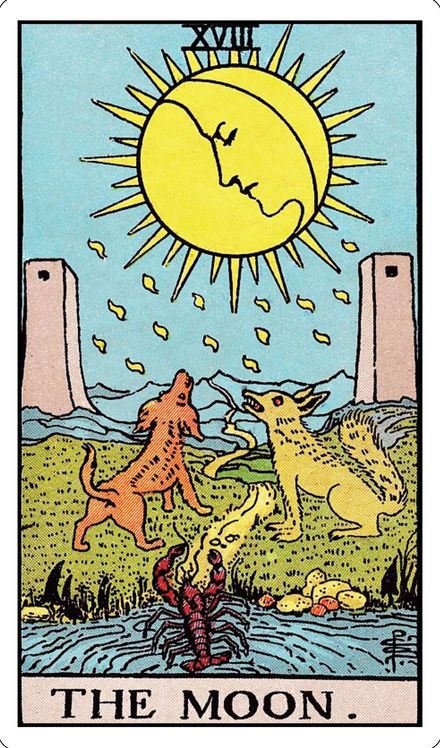
- Deception next to warped perception, a hard pair to read. It suggests something may be hidden, and that your sense of what it is may also be unreliable.
- +Seven of Swords and Five of Swords
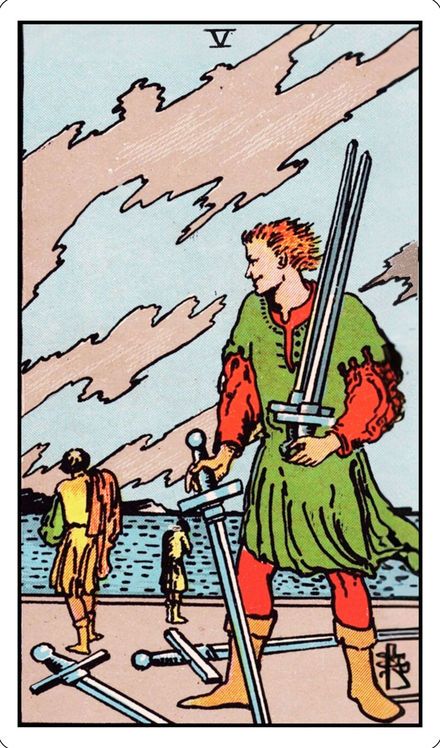
- Two cards about winning in ways you would not want to describe. Together they can point to a conflict being fought dishonestly. It is worth asking by whom, yourself included.
- +Seven of Swords and The Devil
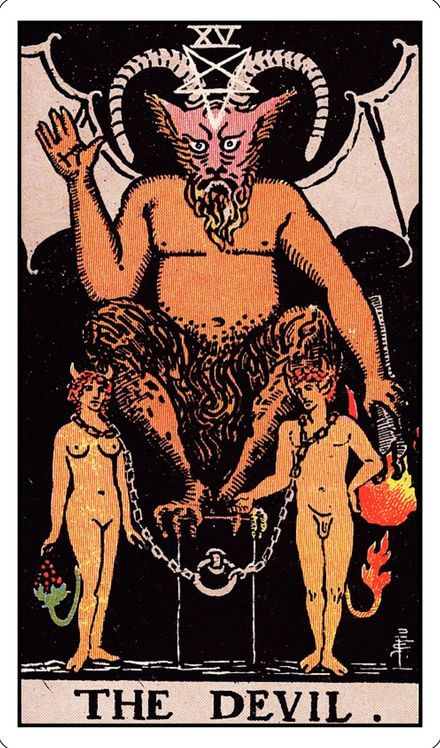
- Hiding and compulsion. Often it means the thing being hidden is a habit, more than a single event. That changes what a confession would require.
- +Seven of Swords and Justice
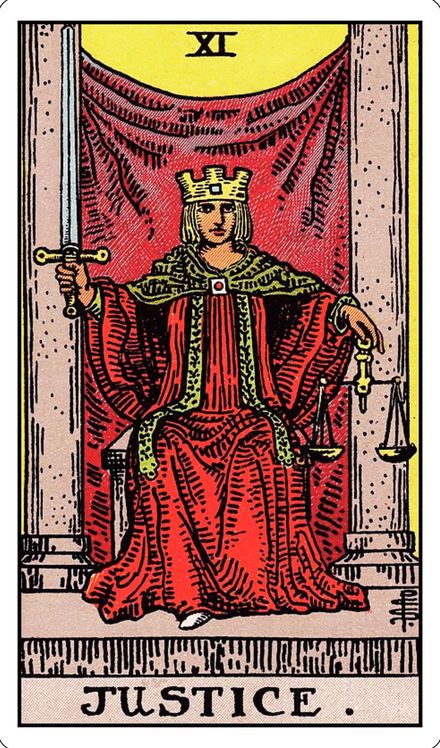
- The shortcut, and the reckoning. A pointed sequence, suggesting that what was got away with may soon be looked at properly.
Every pairing on this site, Seven of Swords's included, is collected on tarot card combinations.
I can do this in a way I would be willing to describe.
Seven of Swords: common questions
- What does the Seven of Swords mean?
- It means taking a shortcut you would rather not explain. A man hurries from a camp with five swords, leaving two behind. Modern readers see deception, strategy, and cutting corners. Waite found it unclear, and gave a scheme, an attempt, and a plan that may fail. No card can confirm what someone else is doing.
- Does the Seven of Swords mean someone is cheating on me?
- It can point to deception in a relationship, and it does not say what kind. No card can tell you what a partner is doing. Evidence and an honest conversation can. Before reading it that way, consider its other common meaning: self-deception, a quietly edited version of your own situation.
- Why does he leave two swords behind?
- Waite describes it plainly: he carries five away, and two stay stuck in the ground. He cannot carry all seven, and that is the most important detail in the card. Whatever is being got away with is only partial. Something stays behind at the scene, waiting to be found.
- What does the Seven of Swords reversed mean?
- Usually the hiding ending: discovery, or a confession made because carrying it became worse than the consequences. It can also mean a plan dropped before it starts. Waite's reversed meanings were good advice and counsel, and also slander and gossip.
There is also a page on what Reflecta does with a reading once the cards are down.